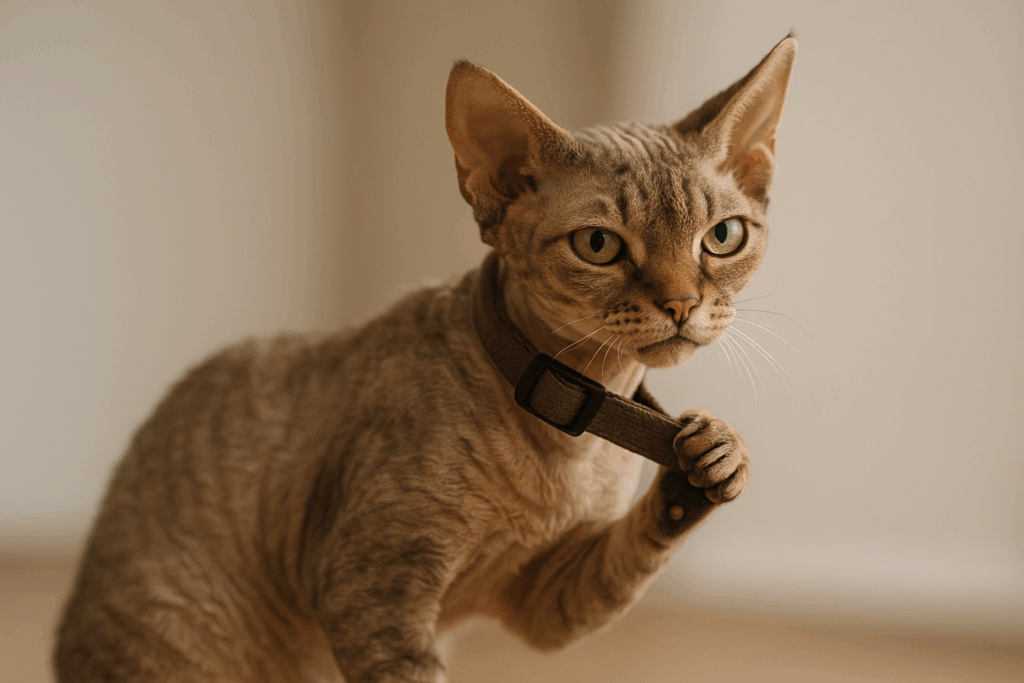
Collars on cats still stir emotions – especially when someone posts a photo of a cat with a small, „cute” strap around its neck. Unfortunately, what looks innocent is in practice often one of the most common and most dangerous items in a cat's „starter kit”.
This guide was created in order to explain why collars on cats are risky, what consequences they may carry, what behaviourists and veterinarians say about them, and how to approach the subject of cat identification safely.
👉 In our cattery Kotki Kędziorki*PL we always point out to future owners that The Devon Rex is an indoor breed (read our guide Walking a cat – is it worth it, is it possible? 2 advantages, 6 disadvantages, and 6 tips). And since the cat does not go outside – a collar is completely unnecessary for it.
At the same time the guide has been written so that it can serve everyone, including those who have outdoor cats.
Why are collars on cats dangerous?
1. The risk of getting stuck and choking
Cats climb… It's their nature. Indoors they go under furniture, into gaps, behind the fridge, on top of the wardrobe. Outdoors, of course, up trees, onto fences, over little fences… A collar can: catch on a branch, a door handle or a cabinet handle, get stuck in a gap, slide off incorrectly and tuck under the armpit, or tighten during a jerk.
These are not rare incidents at all – it is everyday life in veterinary surgeries. Some end in injuries, others unfortunately tragically.
2. “Safety collars” do not give a full guarantee
So-called breakaway collars (releasing under load) are certainly safer than ordinary ones. But: they do not always release when they should, they can open… too easily and the cat loses them, and they can still get caught in a way not anticipated mechanically.
It is an improvement in safety, but not the elimination of risk.
3. The risk of painful abrasions and infections
Even a well-fitted collar can: cause chafing, collect moisture and dirt, lead to skin inflammations, tear out fur.
In cats with delicate skin (like the Devon Rex) this is particularly common.
4. The problem with bells and tags
All the “add-ons” on collars are problematic:
- little bells* they raise stress levels and disturb natural behaviors,
- address tags and pendants easy to snag,
- decorations increase the weight and the risk of a jerk.
A cat does not need jewellery, and certainly not the kind that can endanger it.
* Little bells are, unfortunately, quite a popular but harmful accessory. Many people put a collar on a cat „so that it does not catch birds” or „so that it can be heard around the house”. Unfortunately a little bell is one of the the most harmful forms of accessories for cats. Why? A cat hears several times better than a human – a little bell by its head is constant noise for it. Noise is an unpredictable and uncontrollable stimulus – stress-inducing. Additionally the cat moves quiet by nature – taking this possibility away from it is contrary to its species behaviours. And finally – think how you would feel if you had a bell by your ear 24 hours a day…
A collar doesn't protect the cat, it gives us a false sense of security
Many owners put on a collar in good faith:
“If it got out… so that someone would know whose it is.”
“So that it is visible that it is a house cat.”
Unfortunately, in practice this sense of security is illusory, because a collar:
- does not prevent traffic hazards,
- will not stop a bad person,
- will not protect against other animals,
- does not guarantee that the cat will return.
It is not a collar, but care, education and proper securing of the space are what truly increases cats' safety.
The best alternative: a microchip
A microchip is durable, safe, painless, resistant to damage, invisible and the most effective way to find a cat. It is an absolute standard and a basic element of responsible care.
👉 In our cattery every cat Kotki Kędziorki*PL is permanently marked (precisely by means of a microchip) and registered – before it goes to a new home. Read our dedicated guide entitled „Microchip in a cat – why is it worth it and what does it look like?„
If your cat goes outside – what to do instead of a collar?
For outdoor cats (although for health and behavioural reasons we definitely do not recommend this!), if you absolutely must, then:
- choose exclusively safety collars with a quick-release mechanism,
- do not use any tags or bells!,
- regularly check the skin under the collar,
- use harness, and not a collar, if the cat is walked on a leash.
And if you want to mark the cat visibly – you can use an address tag on the harness, but only under supervision and never in “around-the-clock” mode.
Indoor cats do not need collars! Ever!
If a cat lives in a flat, has a netted balcony, does not go out unsupervised, has no need to be „marked” for the neighbours – then a collar is completely unnecessary for it and only introduces risk.
The Devon Rex – as an extraordinarily human, sensitive and delicate breed – should all the more not wear a collar.
And that is exactly how we educate the owners of cats from our cattery.
How does this look in our cattery Kotki Kędziorki*PL?
We tell all future owners plainly:
✔ our Devons are indoor-only cats,
✔ we do not use collars on any cat*,
✔ we do not send kittens with a collar in the starter kit,
✔ we encourage you to read our guide about indoor cats,
✔ every kitten has a microchip and appropriate registration in the databases.
We want the cats to live long, healthily and without the risk of unnecessary injuries – and giving up collars is one of the simplest but most important decisions in that direction.
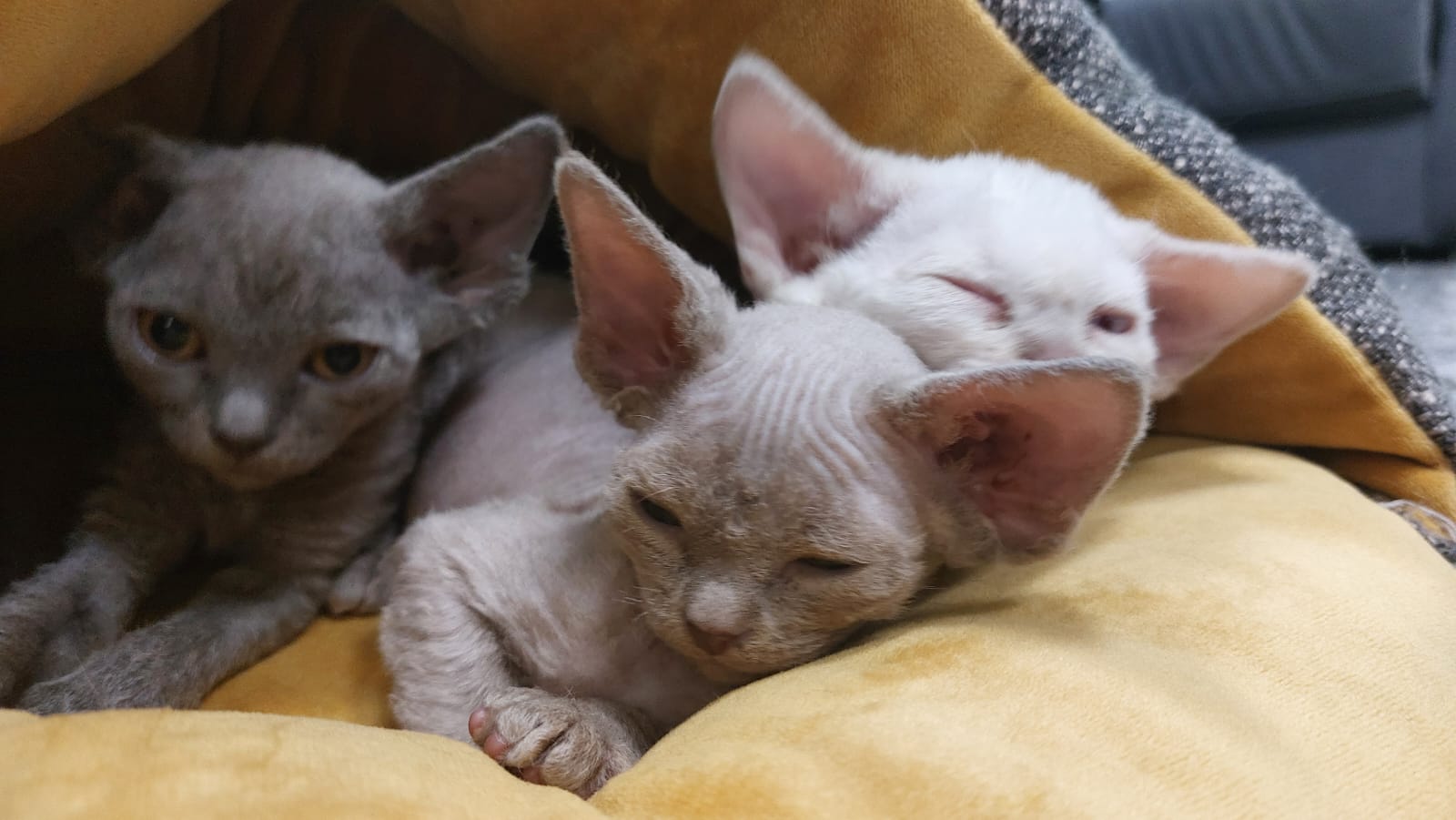
* Sometimes in our photos of little kittens you may see colourful collars. In the cattery we use them only on tiny kittens from a single litter that have identical colouring. They are special soft, ultralight and adjustable fabric bands for breeders. We check and adjust them daily (because the little ones grow quickly); of course they make no noise, don't hinder movement and don't strain the neck. Our kittens also wear them only for a short time.
Summary – the most important things worth remembering
- Collars on cats are potentially dangerous.
- Even so-called “safety” collars carry a risk.
- Indoor cats never need a collar.
- A microchip is the best, effective and durable form of identification.
- A harness is safer than a collar, but only under supervision.
- In our cattery we educate carers in the spirit of animal safety and welfare.
Other interesting posts
What and how should you feed your cat? A guide to cat food
Choosing the right way to feed your cat is one of the most important decisions every owner makes. Diet has a huge impact not only on physical health, but also on a cat's behaviour, wellbeing and lifespan. Feline diet is a topic surrounded by many myths and emotions (also among breeders). After all, every owner wants their cat to be healthy, […]