Cat Shows – what are they like and what are they all about?
Have you ever seen advertisements for a cat show in your area (on billboards, posters or on the Internet)? Maybe you saw that we were (as Kotki Kędziorki) at a show, because we wrote about it on Social Media? Or maybe you have already been to such a show at some point?
In this little guide we want to write what these shows are all about, what they look like, what they are for, who can be at them (both as an exhibitor and as a spectator) and what those strange abbreviations / awards / titles are that cats receive.
Note: The article is based on FIFe show regulations (2025) + our experiences from shows in our federation FPL: Felis Polonia. In other federations (WCF or TICA) certain elements may differ slightly. The article is written mainly for laypeople and visitors (hence a few simplifications which, for breeders / specialists, may be quite significant, but we deliberately chose to describe it this way). If you're a breeder/exhibitor and have your own comments you'd like to add, write to us at mariusz@kotkikedziorki.pl
What is a show and why is it organized?
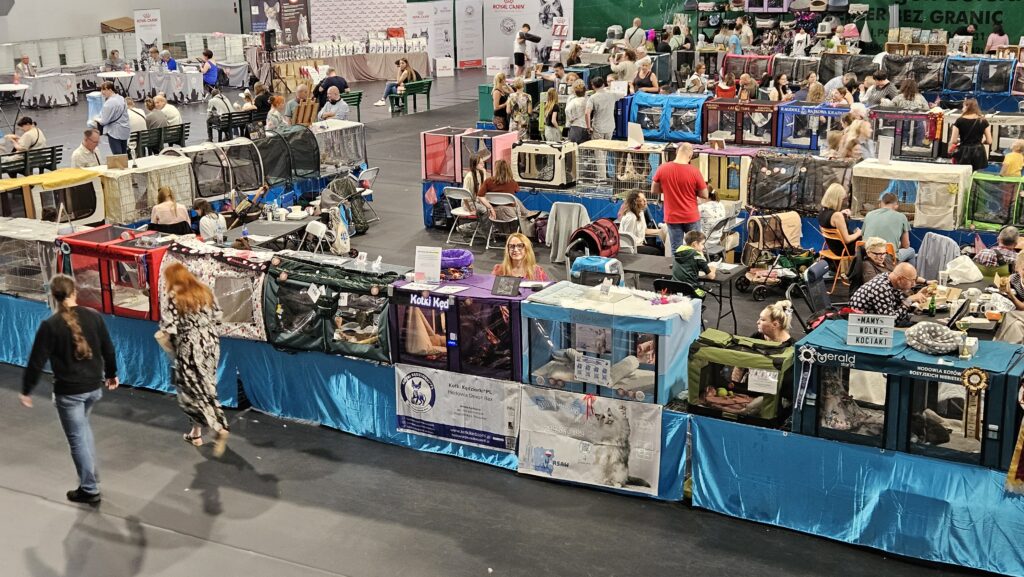
Pedigree cat shows are held many times a year in various places in Poland and the world. Most often they take place on weekends, in large halls – exhibition or sports halls.
They are among the most important events promoting and presenting the world of catteries and cat lovers.
They are organized for several reasons.
For viewers, so that they can:
to see various cat breeds in one place
to ask breeders about a specific breed
to get to know different catteries and their approach
admire the best cats in the Best in Show final
buy many cat-related things*
For breeders, so that they can:
to show off their cats – to the judges and the spectators
have their cats evaluated by professionals (judges)
to promote the breed they breed
to promote their cattery
to meet and exchange experiences
For organizers and judges, so that they can:
to judge the cats + select and reward the best ones
help promote breed standards and spread knowledge about them
to promote responsible animal breeding
* Additionally, at shows, besides breeders and cats, there are always various stands for cat lovers. Here you can find, for example, scratching posts, toys and accessories for cats, producers and distributors of various foods or litters, manufacturers of cat equipment (e.g. litter boxes or vacuum cleaners), and stalls of artists and authors (e.g. making cat-related jewellery, or selling books about cats). So it's also a good place to viewing and buying cat things (in one place and time).
However, what is important – at shows there is a BAN on selling cats, meaning you will not leave the show with a new kitten.
Who can come to a show (as a visitor)?
There are no restrictions, anyone can come – adults, children, teenagers, pensioners. A show is most often on weekends, open from 10 to 17. You can come for as long as you like – it can be a quick 30 minutes, or it can be spending half or the whole day with the cats.
Most often admission to a show is paid, often around 10-50 PLN (depending on the organiser and the type of ticket – standard, reduced, family), although there are also free shows (rather rarely). It is worth checking this information before the show on the organisers' websites.
Who can enter a cat in a show?
It is interesting that a stand with a cat at a show may be occupied by not only a cat breeder, but also the cat's owner (including a „lap” one that has no cattery)!
So if you bought any kitten from us, then You yourselves can also take it to a show! And for us it will be a great pleasure and honor!
We have, for example, one cat mum – Agnieszka, who with our Balladyna has already been to many shows, where Balladyna also received distinctions and awards (she currently holds the title of PREMIOR, i.e. neuter champion, and is in the process of gaining the International Premior title – more about these titles in a moment).
It is important that at a show there can be exhibited cats with a pedigree (apart from a small exception mentioned later, because you can also come with a „household” cat) and you can exhibit not only cats from a cattery, but also those cats bought „as a pet” (neutered).
So once again – if you bought any kitten from us – then you can take it to a show! If you would like to do this – let us know, we will happily tell you and give tips on how to do it (because you have to do a few things beforehand), and maybe one day we will go together 🙂
What does the organization of such a show look like?
If you do make the decision that you want to go to a show (as a spectator) then we have a few useful information for you.
The show usually lasts two days, from about 10 to 17. In theory it does not matter at what time you come, because exhibitors are obliged to be at the show throughout the whole time it is open.
During its opening you can go wherever you want and look at any cats and any catteries (you can spend as much time in any place as you want). You can also look at the stands of various sellers.
IMPORTANT: At practically all shows there is in force NO touching the cats by visitors. Breeders may not give cats to be stroked, visitors should not (even if they have the chance) stroke the cats – all this is dictated by safety and hygiene aspects.
At a show you will most often see two approaches of exhibitors – either they use the organisers' cages (metal cages), where they add some accessories or decoration of their own and a net separating them from the public. Or (as we prefer!) they have their own specialist pens with transparent films. Both types should (in line with what I wrote above) block visitors' access to the option of petting the cats.
How to tour a show?
Usually shows organised in halls (sports or exhibition halls) take up quite a large area, which is divided into smaller sectors. But most often there is no map of which cattery or which breed is where – and very often they are all mixed together! You can simply walk any route and visit different spots (also several times, if you feel like going back somewhere to look at a cat or cattery again).
However, there are a few important aspects, in the context the show's visiting hours (which in theory does not matter, but in practice may matter – depending on what matters to you).
Firstly, it may happen that some a particular exhibitor's stand will be empty – neither they nor the cat will be there – it means they have probably gone with the cat to be judged by the judge (more on that in a moment). If you did not find us (or another exhibitor) by our cage, then come back in a few, several minutes (because that is roughly how long the judging lasts). Sometimes the breeder may also take a break (for the toilet or eating), but then the kitten is often in the cage and you can look at it.
Secondly, if you want to watch the final competition, then come around 15-16, because that is when the so-called Best in Show. In the morning (and anyway up to a maximum of 14-15) the cats are judged individually (each breeder goes separately with their cat to the judge), but Best in Show is gathering the best cats from the show and judging them once more within this small group and selecting the best ones.
Thirdly, if a show lasts two days, then most often (in 95% of cases probably) both days look the same – there are the same breeders, the same exhibitors, the same sellers with stalls and the same judges + a Best in Show final is also held around 16:00-17:00 (although its results may differ from the first day!). So it doesn't really matter much whether you come on Saturday, Sunday or both days – fit it to your own calendar and plans.
* A small note from our experience – it is best to come to the show before 4 p.m.. Because if you come after 16:00 you'll have little time left for viewing + what's probably more important, it happens that some exhibitors leave earlier (especially on the second day, Sunday), so they start packing up and dismantling earlier too. So if you can, we suggest arriving by 16:00 at the latest.
Judging and cat show
So now briefly and greatly simplifying – what does the assessment and showing of cats consist of?
At the show it will be quite a characteristic place where cats are judged by the judges (the so-called ring). Most often it is on some wall opposite the entrance (depending on the hall).
Visitors are not allowed into the ring, but there are often benches and a space behind them, where visitors can watch the judges' work and the judging of the cats.
The cat judging path
Every cat at a show is judged and the way of judging has a certain characteristic course. We will describe the details in a moment, but first look at this little diagram (do not worry about the strange names and abbreviations, we will explain them shortly).
The cat judging path
First comes the individual assessment (each cat individually), which is carried out by each judge at the show (in the group of cats assigned to it for judging). In reality these are precisely all those boxes above except the last one (the final).
Each judge, to each cat – first awards points (0-100), then makes its qualification (G, VG, Ex) and classification (Ex 1-4), then it can award the cat certificate (e.g. CACJ, CAC, CACIB). The certificate is needed by the cat and the breeder to gain recognised titles (you need several certificates for a title), which are added to the cat's name and cattery affix (in the pedigree).
The last stage of each cat's individual assessment is the possible nomination to the final (NOM BIS) and the awarding distinctions the best cat in the assessed colour group (BIV). This is received by selected cats, but every judge has the possibility of awarding these nominations.
Then comes the show final (around 3-4 p.m.), when no longer individually, but by the panel of judges (i.e. all the judges at the show) a group assessment is made of ONLY the best (nominated) cats.
Then the cats can first receive the title BIS (Best in Show), and then this choice is narrowed even further to the title BIC (Best in Category), to finally choose the best cat of the show at BOB (Best of The Best).
All right, let's now move on to the details of this process 🙂
NOTE: If this is already too many strange descriptions for you, then you can stop reading here. You have learned the most important information about cat shows and how, why and where cats are judged. However, if you feel like it, we will now describe the way cats are judged in more detail.
Individual assessments
In the ring cats are judged first individually. Each breeder approaches the judge with their cat and is assessed by them. Often above the ring there is a display showing the judges in columns (each column is one of the judges), and underneath only the numbers are shown.
These numbers are the starting numbers of each cat (they are assigned based on the cats' show entries and are most often grouped by breed at first). On the exhibitors'/breeders' cages you can see what number a given cat has (exhibitors are obliged to pin them to the cages). When the number on the display above the ring goes higher and higher, it means that a given cat will soon be judged and the exhibitor should move with it toward the ring.
The individual assessment of a cat lasts about a few minutes (up to a max. of 10). The judge looks at a given cat and pays attention to several aspects, which are described in the standard of a given breed.
The assessment of each cat is with a score in the range of 0-100 points. Each breed has its own scoring scheme (!), in which different elements of the cat have different weight and importance (e.g. in the Devon the fur and head are crucial, while the eye colour or indeed the fur colour, for example, is of no significance at all).
For the Devon Rex breed, the point distribution looks like this:
Coat – up to 35 points
Head – up to 25 points
Body – up to 20 points
Ears – up to 10 points
Whiskers – up to 5 points
Condition – up to 5 points
So for Devons the most important thing is the coat and head (with its structure – as well as the nose, skull, cheeks + ears + whiskers) – it is these elements that the judges and breeders mainly pay attention to.
Qualification
The points score itself does not appear in the judge's report or in the show results, because here a more important element will be the qualification of the cat into an assessment group:
G – Good – from 61 points
VG – Very good – from 76 points
Ex – Excellent – from 88 points
These „scores” (G, VG, Ex) appear already in the report and the show results.
Classification
After the points assessment and qualification, the judge additionally compares the cat to other cats in various classes, colours, etc. (we do not have room for that here, but we will have a separate article about the details of judging cats at shows).
The first four cats receive a grade – Ex 1, Ex 2, Ex 3 and Ex 4.
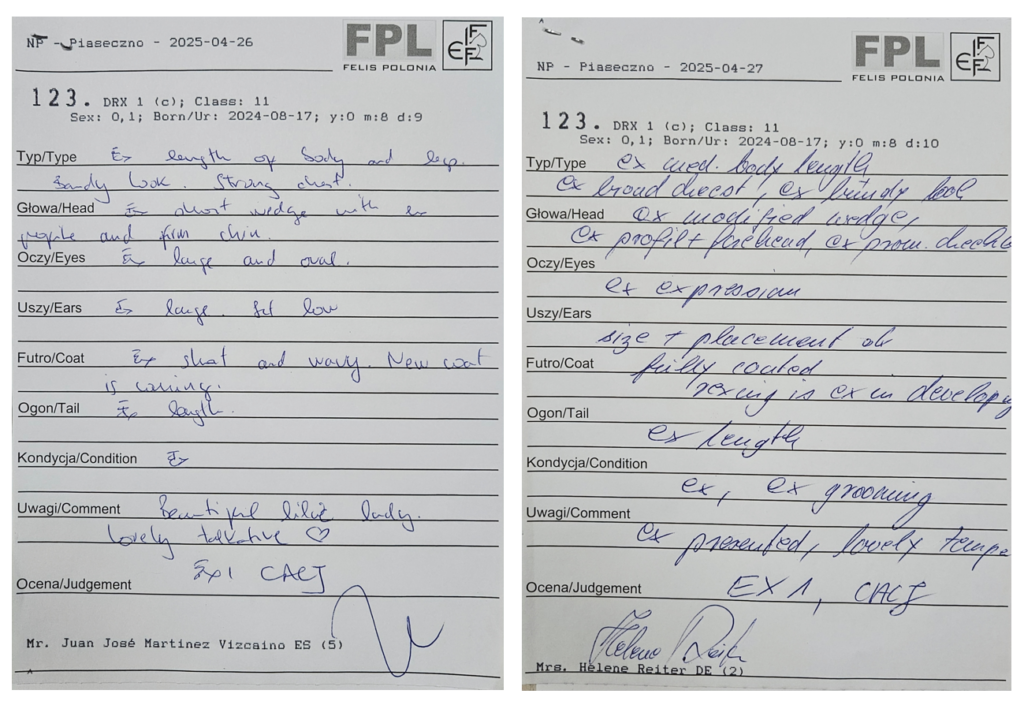
Example: Our GIGA in Piaseczno (April 2025) received Ex 1 on one day from a judge from Spain, and on the second day, also Ex 1 from a judge from Germany. See in the photo below what the judging report looks like after this show – every element of the cat is described + the judge's description/comment, and at the end there's an evaluation – in our case 2x Ex 1 (each on a different show day and from a different judge).
The assessment (judges' protocol) of our cat GIGA at the show in Piaseczno
Certificates
Cats (and breeders) at shows compete for so-called certificates, which they need in order for the cat to be able to earn show titles (of the Champion type).
A certificate can be awarded to a cat only and exclusively if it received the Ex 1 score and has achieved a certain minimum number of points (varying depending on the class it competes in – more on that in another guide), which ranges from 93 to 97 points. Only an Ex 1 grade gives a chance of receiving a certificate (although an Ex 1 grade doesn't always have to end with a certificate being awarded, but those are rather very rare exceptions).
Example: Our GIGA in Piaseczno (April 2025) received on one day her first CACJ certificate (because she got the Ex 1 score) from a judge from Spain, and on the second day, she got a second CACJ certificate from a judge from Germany. Look at the photo above – after the Ex 1 qualification, there is an annotation of the certificate won – CACJ.
The cat then needs a specific number of such certificates, in order finally to win one day a show title in its class. There must be at least 3 of these certificates (for the Champion and Premior titles), each from a different judge.
Example: Our GIGA has earned 2 CACJ certificates. In order for her to receive the show title Junior Champion, must have at least 3 such certificates. We could not do this in the 2 days of the show in Piaseczno, so we will have to go to another show to fight there first for a score of >88 points, to get the Ex 1 qualification, to get the CACJ certificate.
Nomination for the final
Another important element of the individual assessment is the so-called nomination (described by the abbreviation NOM) to the show's final, i.e. Best in Show (described by the abbreviation BIS).
Each judge can nominate 8 cats for the final (2×4 = 2 sexes x 4 groups: kittens, juveniles, adults, neuters) in each judged category.
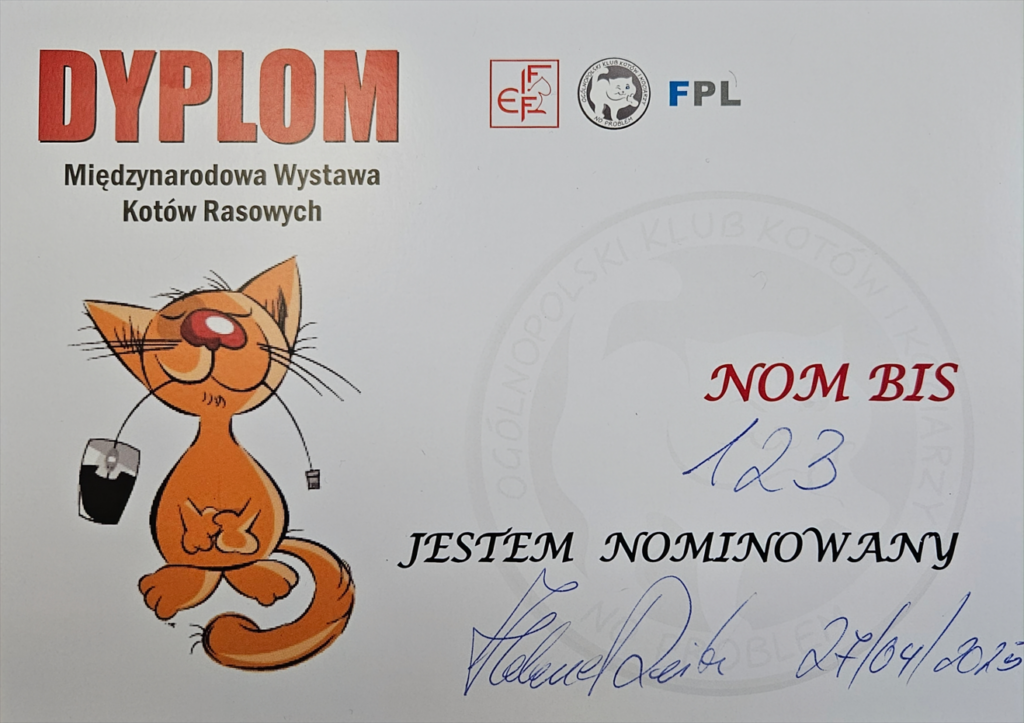
The cat then usually receives a mini-diploma or some badge/pendant (which you can see on the exhibitors' cages during the day). It is an important distinction for a cat at a given show.
Nomination for the final – Best In Show (NOM BIS) for our GIGA
The show final
In the final of each show there are presented the best cats chosen by the various judges and nominated by them to this final (i.e. all those with a nomination – NOM BIS). And this is the part of the show when the judges gather together and together also (as the panel of judges) judge the best cats.
Here the final is divided (usually) into 4 categories of cats (longhair, semi-longhair, shorthair and others).
Then in each category there appears division into classes: kittens, juniors, adults and neuters + additionally, in each, also by sex. On top of that there's an extra group of veterans (males and females) and litters – of course, if there are any at the show (because not every show has them). So usually we have 8 or even up to 11 „groups” of cats to be judged (in 1 of the 4 categories).
In the final it starts with the presentation of a specific category, and within it the individual classes of cats. Then in each such class the cats are presented all at once to all the judges. Each cat is on its own little table (there are 2 to 5-6 such cats in a group) and the judges approach each of them separately. From among these few cats each judge votes (openly) for one and only one.
The one that received the most votes, receives precisely the BIS title – Best in Show. In each category (of which there are 4) 8+ BIS titles can be awarded (both sexes in: kittens, juniors, adults, neuters). So the number of awarded cats can be over 30. But these are already the laureates, who also receive material prizes from sponsors and organisers.
Then from among all the cats awarded BIS in a given category (1 of 4), the best cat in the given category is chosen and receives the title BIC – Best in Category.
At the end the best from among all the categories (i.e. BIC) compete for the most important title of the show BOB – Best of The Best. Here 4 specific places are awarded: BOB 1, BOB 2, BOB 3 and BOB 4.
To sum up then, there are 3 titles/awards that cats can receive in this final (going to the most important ones):
BIS: Best in Show – awarded in each class and each category (30+ cats awarded)
BIC: Best in Category – awarded in one category (i.e. a maximum of 4 cats awarded)
BOB: Best of the Best – awarded only 1 for the whole show (though with 4 numbered places)
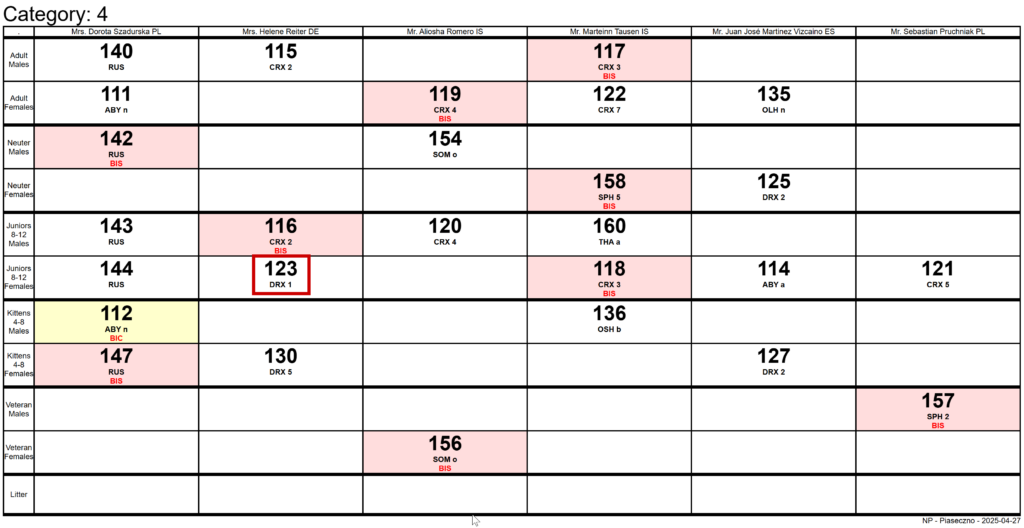
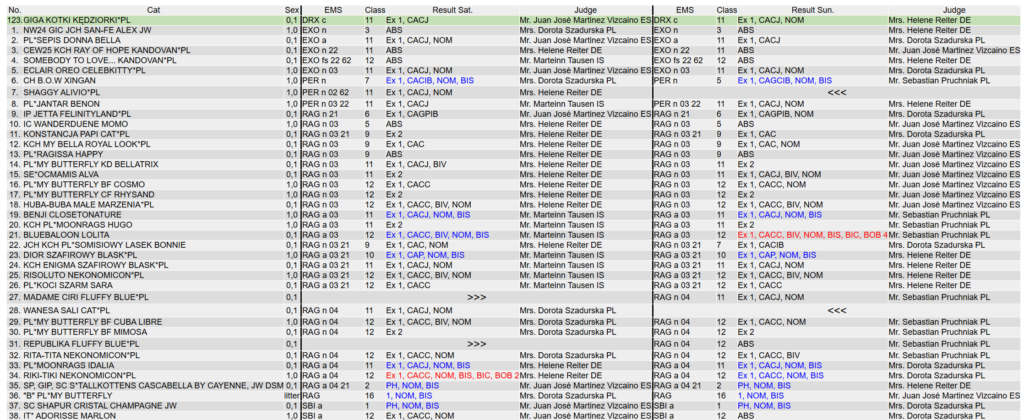
Example: Below is an example of the judging in category 4 (which includes, among others, Devon Rexes), where at the show in Piaseczno our GIGA received a nomination (NOM) and then appeared in the BIS final. We had number 123 in the show catalogue (and that is how it is presented on the monitors). And as you can see in a horizontal line – she competed in the group/class Juniors (8-12) Females. There it competed against a Russian Blue (144), two Cornish Rexes (118 and 131) and an Abyssinian (114). In the end, the BIS in our class was won by the Cornish numbered 118 (highlighted in pink and marked BIS), and the best cat of the whole category 4 (i.e. not only of the horizontal row, but of the entire table) was the Abyssinian numbered 112 (highlighted in yellow and marked BIC). This Abyssinian ultimately also won the BOB1 award, meaning it was the best cat of the whole show.
An example of BIS in category 4 from the show in Piaseczno – our GIGA (number 123)
Show results
At the end of each show such results are published (at least in the FPL federation), where anyone can view the results of a given show and see all the awarded cats.
All FPL show results are available on the website: https://catshow.eu/ – where you can look at every show. If you are interested in a summary of the whole show, then on the results subpage of a given show take a look at the section: Quick catalogue & Results > ALL.
BIS scores are marked in blue, and BIC/BOB scores are marked in red (to make them easier to spot).
Summary
And that's probably all we wanted to show and share with you. We hope that you'll now be able to go to a show more knowingly (which we very strongly encourage). You'll know what to expect, how to make good use of your time, how to view the cats during the show and in the final, and how to see the very best cats of the whole show.
If you are at a show where we will be too – then Be sure to come and say that you know us and recognise us – that is really nice. You can also ask us any question. See for yourselves, by the way, in our post on Facebook, what questions we were asked during the show in Piaseczno in April 2025.
Also follow our Social Media (for this topic best of all Kotki Kędziorki on Facebook), because there we announce when and where we are at a show. We rather choose shows in our area (the Mazovian Voivodeship), but who knows, maybe you will meet us in other places too.
Ah – if you want to see which shows we have already taken part in, and which of our cats were with us at them + what scores, certificates and titles they won – for this we have prepared a dedicated page Kotki Kędziorki at Shows.
The first days in a new home are a big event – both for the cat and for its owner. See how to wisely introduce a cat to a new home, i.e. what „settling in” and socialisation with isolation are.
Cat socialisation is one of the most important stages in a cat's life, especially in its first days and weeks. It is precisely then that its reactions to the world, to people and to other animals take shape. In our cattery we attach enormous importance to this.
Choosing a cattery is one of the most important decisions a future cat owner makes. It is the breeder who determines not only the health and temperament of your future pet, but also the first experiences and socialisation that shape a cat's personality for life. That's why, before you decide to get in touch or reserve a kitten – it's worth carefully checking reviews about the cattery. Only... where […]