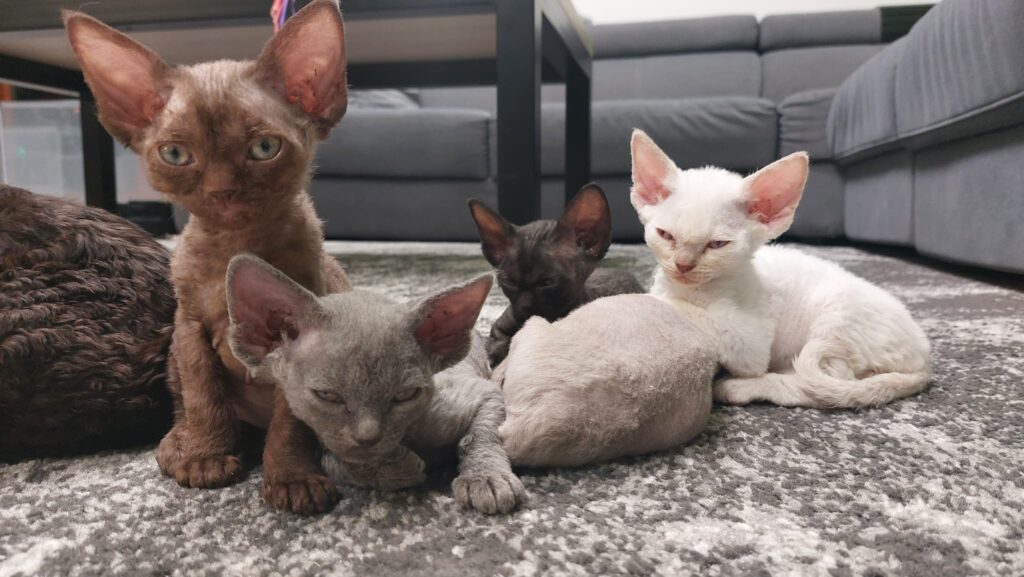
Devon Rex is a super sweet cat with very distinctive large ears, a very short coat and the look of a little alien.
It also has an extraordinary, friendly nature and intelligence. It is very easy to care for and very affectionate.
Devons become very strongly attached to their owners and therefore often demand affection, petting, cuddles, playtime, and attention. They get along wonderfully with other animals, but humans always come first in their hearts. Devons are true world champions of purring and snuggling up to people.
Devon Rex cats belong to the Siamese and Oriental group of cats (Category IV according to FIFe), although they originally come from England (the breed has existed since 1960). In terms of size, they are medium-sized cats (2–3 kg for females and 3–4 kg for tomcats). Their length is about 50 cm.
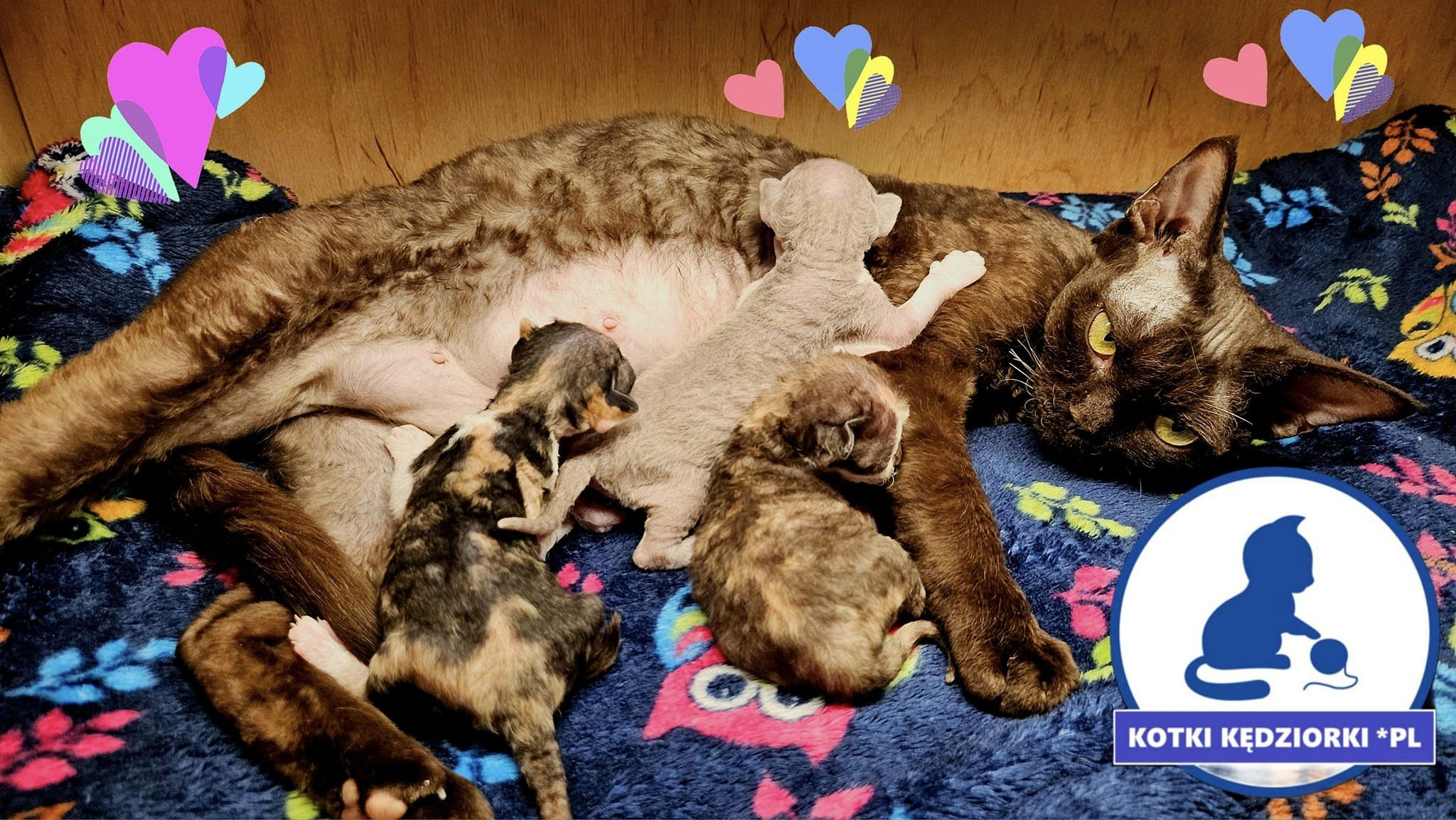
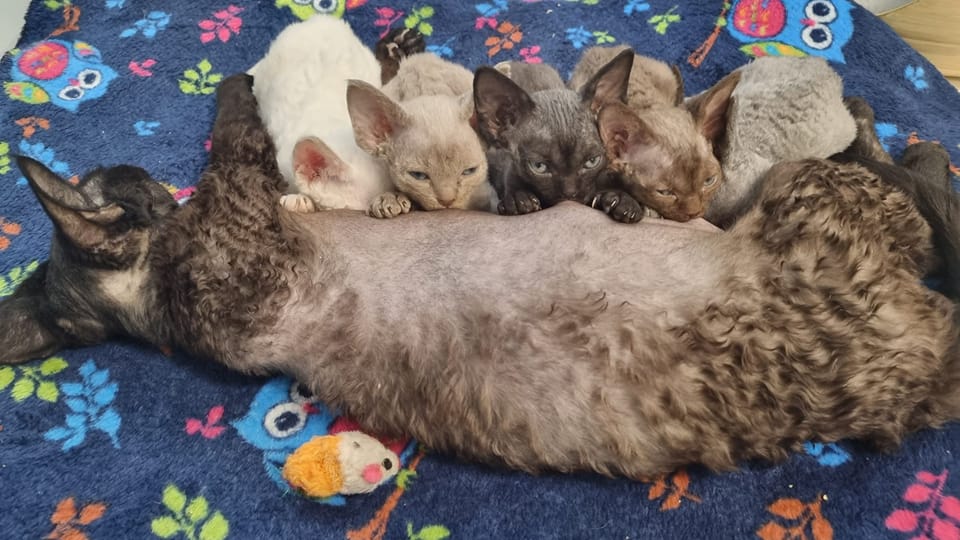
Atena with Litter D
1 / 6
Devon Rex Coat / Fur
Devons have a very short coat, which is why they are so unusual and why some people mistake them for Sphynx cats at first glance (which have no coat).
However, their fur is delicate, soft-textured, and very pleasant to the touch – it is a little hard to describe; it is best to feel it for yourself. The coat is usually gently wavy or curly (yes, the name of our cattery is a pretty nice match for this trait and our surname!). It is sometimes described as karakul-like.
Devon hardly sheds at all, and its coat requires no grooming (combing or brushing). It also leaves much less fur around the house than domestic shorthairs or longhaired breeds. Depending on the cat and its color, the fur in the house may be practically unnoticeable.
Is Devon Rex a cat for allergy sufferers?
There is a belief that it is one of the least allergenic cat breeds! Unfortunately, that is not entirely true…
„Cat allergy” is not directly related to their coat, as is often believed, but to proteins found in their saliva, sebum, or shed skin. The main allergen is the Fel d 1 protein, which is found in the secretions of the sebaceous glands and in the cat's saliva. When a cat licks its coat during grooming, this protein settles on the fur and is then transferred into the environment in the form of microscopic particles. These tiny particles float in the air, settle on furniture, and can be inhaled, leading to an allergic reaction.
It is worth noting that the coat itself is not an allergen, but it acts as a carrier of allergens. Therefore, it is not the length or density of the coat that determines how strongly it causes allergies, but the amount of Fel d 1 protein produced by the cat. Some breeds may be described as less allergenic because they produce smaller amounts of this protein, but no breed is fully hypoallergenic.
Due to their very short coat (and the fact that they leave almost none of it behind), Devon Rex cats may potentially trigger allergies less than other breeds. However, for people with allergies we advise caution, because it all depends on individual tolerance to allergens.
To reduce the risk of an allergic reaction, it is recommended to clean the areas where the cat stays regularly and to use air purifiers. In the case of people with severe allergies, it is worth consulting an allergist, who may suggest appropriate treatment or desensitization therapy.
Ears, eyes, whiskers
Besides the characteristic coat described above… they also have very distinctive large ears and expressive eyes – this is very often what catches the eye of people who have never seen them before. Large ears are a hallmark of Devons and are highly valued at cat shows.
Another distinguishing feature is their whiskers and eyebrows. They are usually very short and barely visible, sometimes curled. This is because they are quite fragile, so Devons' whiskers break very easily. However, it does not bother them at all, and in our opinion it even adds charm and uniqueness.
Their body temperature is naturally elevated (about 39 degrees), so they are very warm to the touch. They also love warm places – including lying on people's stomachs, on or under a blanket next to a person, and even using electric blankets. You can very often find them lying on a radiator.
Devon Rex colors
Devon Rex cats come in virtually all color varieties and everyone will surely find a kitten in their favorite color.
In very simple terms, you can find Devons in several main color varieties:
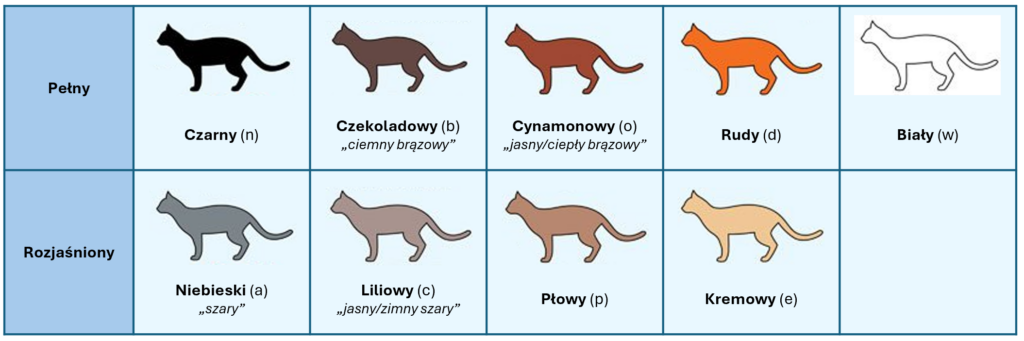
Solids – the cat has only one color throughout its entire body (uniform) – in 9 available colors (below)
Points – the cat is "white/light", but has color on the ears, muzzle, paws, and tail
Patched – the cat has some main color + has white spots/patches/color in various places
Tabbies – the cat has some main color + has stripes (like a tiger/leopard)
Tortoiseshells – the cat has some main color + additionally red coloring
Basic colors of Devon Rex cats
If you are interested in details of Devon Rex colors and their notation in the EMS system (which we use when listing cats' colors on the website and on social media) – then visit our separate Devon Rex Colors subpage.
Devon Rex temperament
From our observations and experience, they are cats that are very cheerful and sociable (although sometimes they can switch off and disappear for half a day), who love people, often run and jump, and are similar to dogs in play and temperament (some even walk on a leash). They love affection, happily jump onto laps, and wait to be petted.
They are also very curious, brave, and… nosy. They are very intelligent animals, and they need different challenges and interesting activities to be happy. They enjoy exploring new places in the house and having new experiences with interesting things we bring home (e.g. favorite cardboard boxes).
They are very energetic, agile, athletic, and nimble cats. They can play with all sorts of random things – a pen, a stick, a ball, etc. They love to play in many ways – including with people. They can chase a teaser toy for hours. They climb like little monkeys.
They are ideal companions for children – they are patient and do not show aggressive behavior. When they do not feel comfortable, they may give a light scratch or nip (harmlessly), but most often they simply walk away.
They also become very attached to their owners, seeking closeness and attention. They climb onto laps, onto stomachs; sometimes you can hardly get them off you. At the same time, they are gentle cats and make wonderful full-fledged family members.
It also seems that they understand human emotions very well. They can adapt to the mood at home – sometimes energetic, sometimes quiet and withdrawn. They often offer support when we are sad or ill – they come and lie on us or right next to us.
Devon Rex cats feel best in the company of other Devon Rex cats (although other breeds and animals can be great too), and they thrive much better when there is more than one such cat in the home (though of course you need to prepare properly and handle the socialization in the right way). You can read 6 reasons why Devon Rex cats should be adopted in pairs. And Devon Rex cats are addictive… Once you have one, you want another 🙂
Health
The Devon Rex is a hardy and long-lived cat (they can live up to 20 years!).
They are generally not very prone to common feline illnesses (compared to other cat breeds). Despite their very delicate coat, they very rarely catch colds or get sick.
This breed also does not have any typical breed-specific conditions and is NOT a breed that has been unnaturally altered or shaped by genetic changes (such as a shortened nose or excessive refinement).
However, to be 100% transparent, it is worth mentioning that the health issues they do encounter are mainly food allergies, which can usually be resolved by choosing the right diet or even simply removing one specific ingredient. Sometimes they also tend to have blocked or overgrown tear ducts.
Breed standard
Like every officially recognized breed in FIFe, Devon Rex cats also have a strictly defined so-called „breed standard”. It is a fairly detailed description of what the ideal Devon Rex should look like.
The description is divided into several categories (head, ears, eyes, body, legs, tail, and coat) and subcategories (for example, within the head category – shape, cheeks, muzzle, nose, whiskers).
Below you will find our Polish translation of the Devon Rex breed standard (the original is available only in English, German, and French).
Head
Shape (Shape): A short, broad wedge (but not rounded when viewed from the front)
Forehead (Forehead): Rounded, curving into a flat skull
Cheeks (Cheeks): Very prominent cheekbones, full cheeks
Nose (Nose): Short, with the rounded forehead creating the impression of a stop
Muzzle/Chin (Muzzle/Chin): A short, broad muzzle with a strong chin and a „whisker break”
Whiskers/Eyebrows (Whiskers/Eyebrows): Wavy, rather coarse, and of medium length
Ears
Shape (Shape): Very large, very broad at the base, tapering to rounded tips. Well covered with fine hair; with hair (or no hair) growing from the fold behind the ears, forming earmuffs
Placement (Placement): Set very low
Eyes
Shape (Shape): Large, oval, well spaced; slanting toward the outer edges of the ears
Colour (Colour): Bright; pure and clear in colour
Neck: Long and slender
Body
Structure (Structure): Medium in length, firm and muscular, slender. Broad chest.
Legs
Long and slender. The length of the hind legs is emphasized. The front legs are set on the body in a way that gives a slightly bowed appearance (the so-called „bandit look”)
Paws (Paws): Small and oval
Tail: Long, thin, and tapering; well covered with short hair
Coat
Structure (Structure): Very short and delicate; soft, wavy and/or curly, with or without „guard hairs”. Hairless areas are allowed only in cats up to 12 months of age
Devon Rex cats do not have defined permitted coat or eye colours – they can appear in any colour combination.
How much does a Devon Rex cost?
It is hard to answer the question „How much does a Devon Rex cat cost?” in just one sentence.
However, you can assume that a cat from our cattery kosztuje około 5800-6200 PLN (in the „pet only” option), and the sale price depends on several factors (including sex). We encourage you to contact us if you are interested in buying a kitten from our cattery.
Oczywiście cena kota w opcji „do hodowli” będzie dużo wyższa i zaczyna się od około 20.000 PLN (kociczka).
More about Devons
Take a look at a few other interesting articles on our website about Devon Rex cats:
Adoptować kota ze schroniska czy kupić go z hodowli? Czy któraś opcja jest lepsza? Z czym wiążą się obie opcje? Przeczytaj nasz poradnik w tym temacie.
BARF to temat, który wcześniej czy później pojawia się chyba w życiu każdego bardziej świadomego opiekuna kota. Jedni słyszą o nim i myślą: „Kot powinien jeść mięso – to ma sens!”. Inni widzą listę suplementów, wagę kuchenną, kalkulator i kilkanaście różnych składników i zastanawiają się: „Ale po co sobie to wszystko komplikować?” 😄 Prawda jest… Read more: BARF dla kota – co to jest, jak zacząć i czy naprawdę warto?
Early neutering of cats, carried out before they reach sexual maturity, is standard in responsible catteries. It provides health benefits, minimises stress and simplifies life for new owners. This practice, supported by experts, is aimed at ensuring the safety and health of cats, not at profit for breeders.
Obroże u kotów wciąż budzą emocje – zwłaszcza kiedy ktoś wrzuca zdjęcie kota z małym, „uroczym” paskiem na szyi. Niestety, to co wygląda niewinnie, w praktyce bywa jednym z najczęstszych i najbardziej niebezpiecznych elementów kociej „wyprawki”. Ten poradnik powstał po to, aby wyjaśnić, dlaczego obroże u kotów są ryzykowne, jakie konsekwencje mogą nieść, co mówią… Read more: Obroża u kota – dlaczego jest niebezpieczna?
Ból u kotów to jeden z najbardziej niedocenianych tematów w ich codziennej opiece. Nie dlatego, że koty rzadko cierpią – ale dlatego, że pokazują ból zupełnie inaczej, niż się spodziewamy. Nie krzyczą. Nie proszą. Często wręcz przeciwnie – chowają się, wycofują, „zamykają”. W naszej hodowli Kotki Kędziorki*PL mieliśmy pewne sytuacje, w których szybka reakcja uratowała… Read more: Ból u kota – jak go rozpoznać i kiedy reagować?
Dosyć często trafiają nam się pytania o Devon Rexy od osób, które nie do końca jeszcze znają tą rasę, lub które mają inną rasę kota, a jednak z jakiegoś powodu zainteresowały się Devonami. Pomyśleliśmy więc, że stworzymy (poza istniejącym już opisem podstawowych informacji o rasie Devon Rex na naszej stronie) – poradnik dla osób szukających… Read more: Dlaczego Devon Rex? A nie inna rasa?
Wybór hodowli to jedna z najważniejszych decyzji, jakie podejmuje przyszły opiekun kota. To właśnie od hodowcy zależy nie tylko zdrowie i charakter przyszłego pupila, ale też pierwsze doświadczenia i socjalizacja, które kształtują kocią osobowość na całe życie. Dlatego zanim zdecydujesz się na kontakt lub rezerwację kociaka – warto dokładnie sprawdzić opinie o hodowli. Tylko… gdzie… Read more: Jak i gdzie szukać opinii o hodowli kotów – 5 miejsc do sprawdzenia
Wybór odpowiedniego sposobu żywienia kota to jedna z najważniejszych decyzji, jakie podejmuje każdy opiekun. Dieta ma ogromny wpływ nie tylko na zdrowie fizyczne, ale też na zachowanie, samopoczucie i długość życia kota. Kocia dieta to temat, wokół którego krąży wiele mitów i emocji (również wśród hodowców). Każdy opiekun chce przecież, by jego kot był zdrowy,… Read more: Czym i jak karmić kota? Przewodnik po kocim jedzeniu
Czasem zdarza się, że ktoś zapyta nas – skąd takie „dziwne” imię dla kota? I to „dziwne” pojawia się często przy kotach, które mają mniej standardowe imiona niż np. Chmurka, Atena, Bella czy Kiwi. Więc chyba czas opowiedzieć Wam małą historię i to, skąd biorą się niektóre imiona naszych kotków. Aneta jest z wykształcenia fizykiem… Read more: Fizyczne koty – czyli skąd są niektóre imiona Kotków Kędziorków?
The first days in a new home are a big event – both for the cat and for its owner. See how to wisely introduce a cat to a new home, i.e. what „settling in” and socialisation with isolation are.