A cat's pedigree – what is it and why is it important?
A pedigree is an official document confirming the origin of a pedigree cat. It is issued by recognised feline organisations (more on that in a moment) and serves as a kind of „identity card” for the cat, containing information about its ancestors, breed and cattery.
Why a pedigree?
For the buyer, it is not just an ordinary piece of paper or a breeders' invention. A pedigree is a guarantee of the cat's pedigree origin (with specific ancestors and genetic history), a purchase from a legal cattery, meeting the breed standards* (and not just resembling a „cat of the breed type”).
there are NO pedigree animals without a pedigree! Every pedigree cat from a legal cattery should have a pedigree, and if you are buying a cat make sure you receive it, absolutely, without any additional conditions.
* Note: The Devon Rex breed standard is described in great detail (on the FIFe website) and on its basis breeders should plan their litters and strive for the ideal. Nevertheless, there are different catteries, different litters, and some kittens may resemble the Devon more or less. Good catteries should aim to make their cats as close to the breed standard as possible.
Who issues the pedigree? When is a cattery legal?
What is the deal with these strange abbreviations like FPL, FIFe, WCC? If you dream of a pedigree kitten, make sure that the cattery where you want to buy it is under the auspices of the world organization WCC, or World Cat Congress.
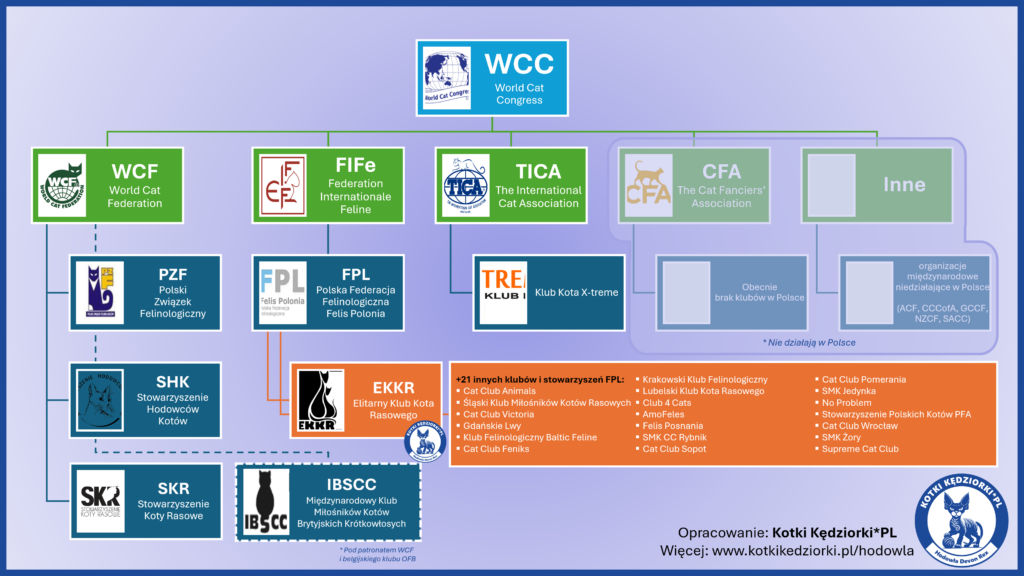
It brings together international organizations, four of which operate in Poland: FIFe, WCF, TICA and CFA (the last of these has no clubs in Poland). In the case of FIFe, its Polish representative is FPL, that is the Polish Felinological Federation. And FPL has more than 20 associations and clubs, and our cattery belongs to one of them (EKKR).
And this is what the whole tree of catteries, clubs, associations, federations, and unions looks like. Our cattery (as we wrote above) belongs to EKKR, FPL and FIFe.
Diagram of the WCC organization and the federations (FIFe, WCF, TICA, CFA) and associations operating in Poland.
If you buy a kitten from a cattery, make sure it will be a pedigree issued by FPL, WCF or TICA. And a given cattery belongs to one of the clubs, associations or societies, which ultimately belong to the WCC.
* Note: Unfortunately, due to the shortcomings of the Animal Protection Act, it has been possible for many different Associations to arise, which also have the right to issue their own „pedigrees” and can legally sell ANY cat with such a document, even if the parents are merely resemble a given breed. That is why it is so important to check whether the issued pedigree comes from one of the WCC organizations (i.e. FIFe, WCF, TICA, CFA). Also see the page that lists associations that are NOT members of any WCC organization, and yet they operate in Poland – it's best to steer clear of them…
What does a pedigree contain?
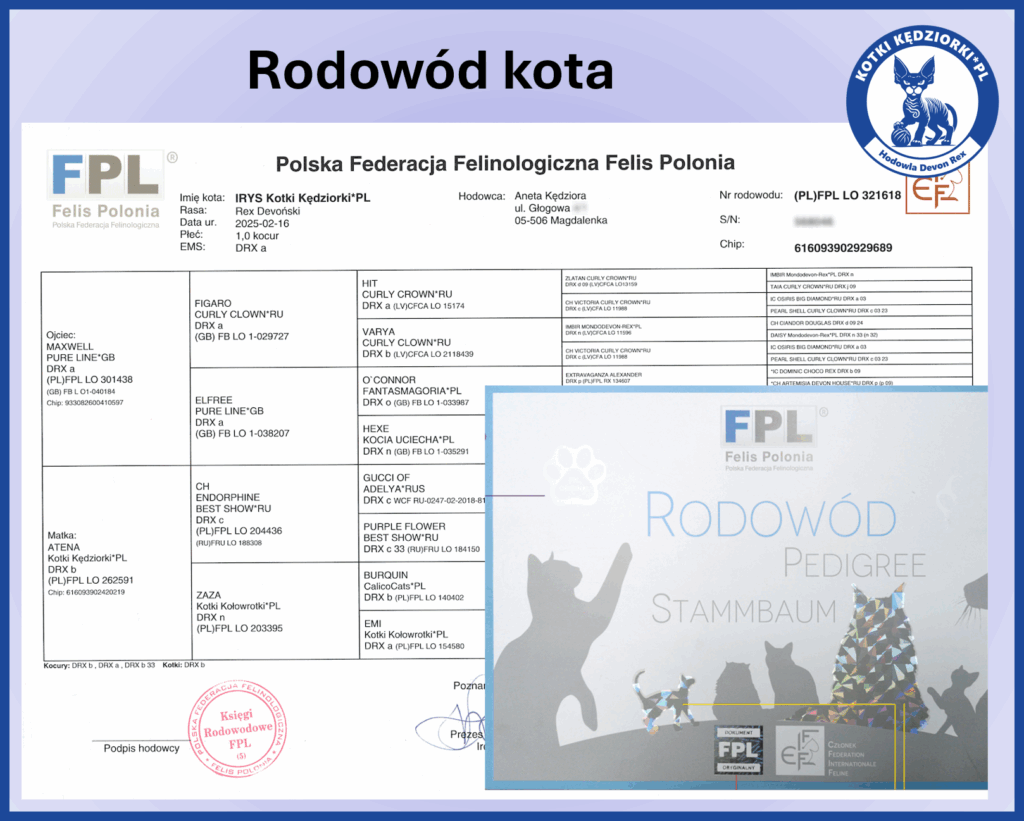
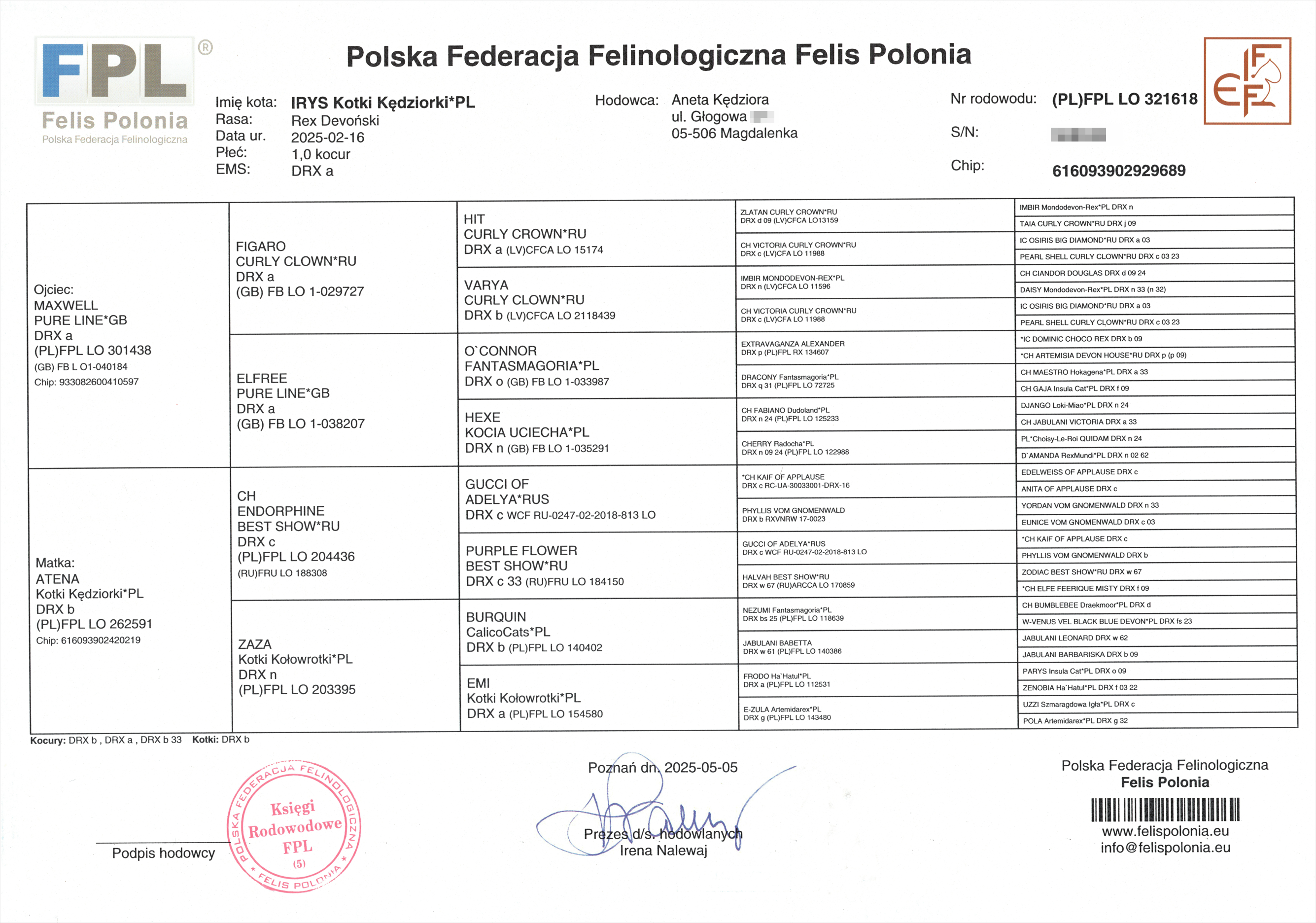
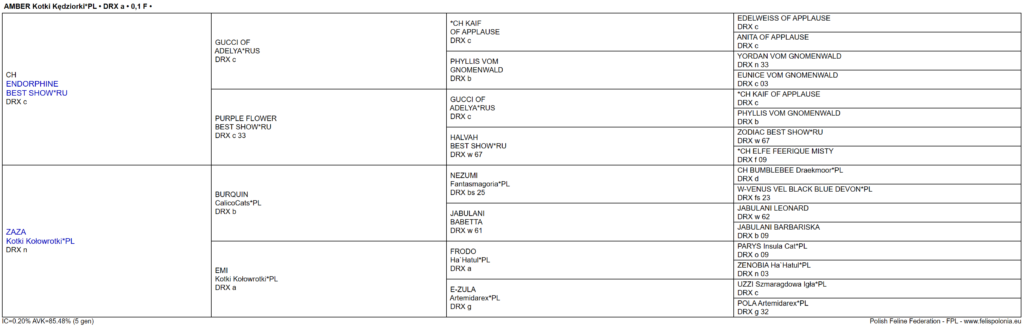
We will show you this using the example of our pedigree issued by FPL (the Polish Felinological Federation Felis Polonia), which belongs to FIFe and WCC.
Note: Pedigrees from TICA and WCF (also belonging to WCC) look a little different, although they retain a lot of very similar information.
Information about the cat
The pedigree in the upper part contains basic information about the cat:
📌 The cat's name and the cattery name, e.g. AMBER Kotki Kędziorki*PL 📌 Breed in verbal form (Devon Rex) 📌 The date of birth 📌 Sex (recorded as „0.1 female” or „1.0 male”) 📌 The cat's color in the EMS system (e.g. DRX a, read more about EMS colors) 📌 The pedigree number (and serial number S/N) unique for each cat in the organization 📌 The cat's chip number, that is, its basic and unique „registration number”
The cat's ancestors
In the middle part the pedigree contains a record of the cat's 5 generations (the father always in the upper part, the mother in the lower), and more specifically for each ancestor information is available about:
📌 Titles and achievements, before the cat's name, e.g. CH (Champion), GIC (Grand International Champion) testify to the high standard of the cats in the line. 📌 The cat's name and the prefix (cattery name) 📌 The breed and color recorded in the EMS system 📌 The pedigree number 📌 Chip number (for the sire and dam, without further generations)
These data allow you to assess what the line of ancestors of a given cat looks like, which catteries they came from, what titles and achievements they won (as of the date of issuing the pedigree).
For breeders it is a large database of information precisely about ancestors and colours. By the way, right below the ancestor table you will also see entered the colors of a given queen's kittens (if she had any) as of the date the pedigree was issued.
Other information
At the end of the pedigree (at the bottom) you will see:
📌 the seal of the FPL pedigree books 📌 the signature of the breeding president 📌 the pedigree issue date 📌 a place for the breeder's signature.
The authenticity of the pedigree
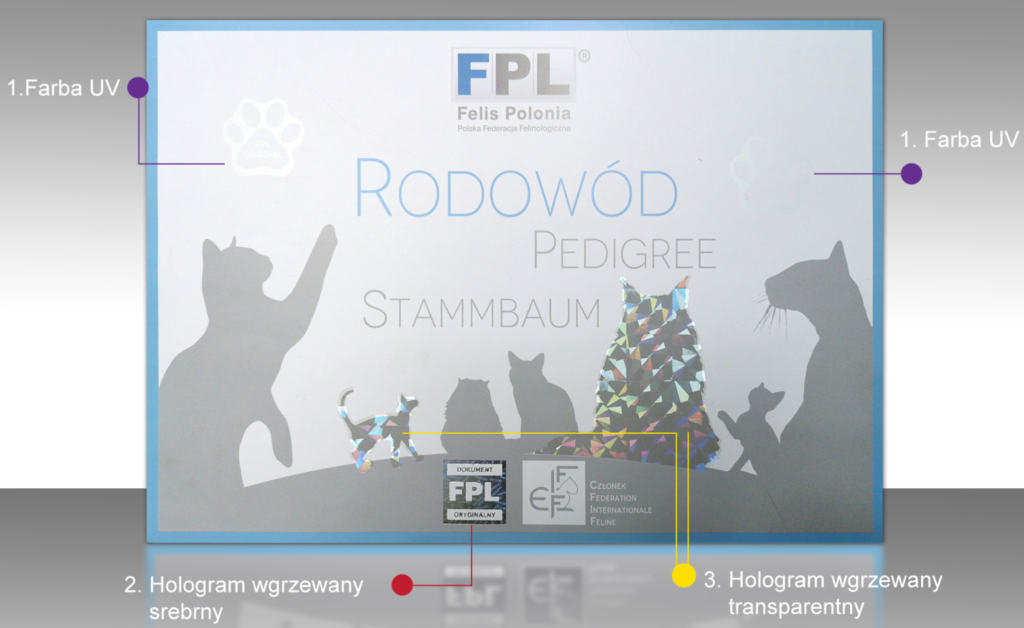
The pedigree you will receive from us has many professional security features confirming its authenticity, including locally applied UV paint with the shape of a cat's paw and the abbreviation of the FPL federation name, a dedicated heat-sealed silver hologram, locally applied heat-sealed transparent holograms on selected cat silhouettes, and a personalised dry seal (on the reverse of the document). You can read more about the pedigree and its security features on the FPL website.
The front of the pedigree: The title page and FPL security features
Checking pedigrees (only in FPL)
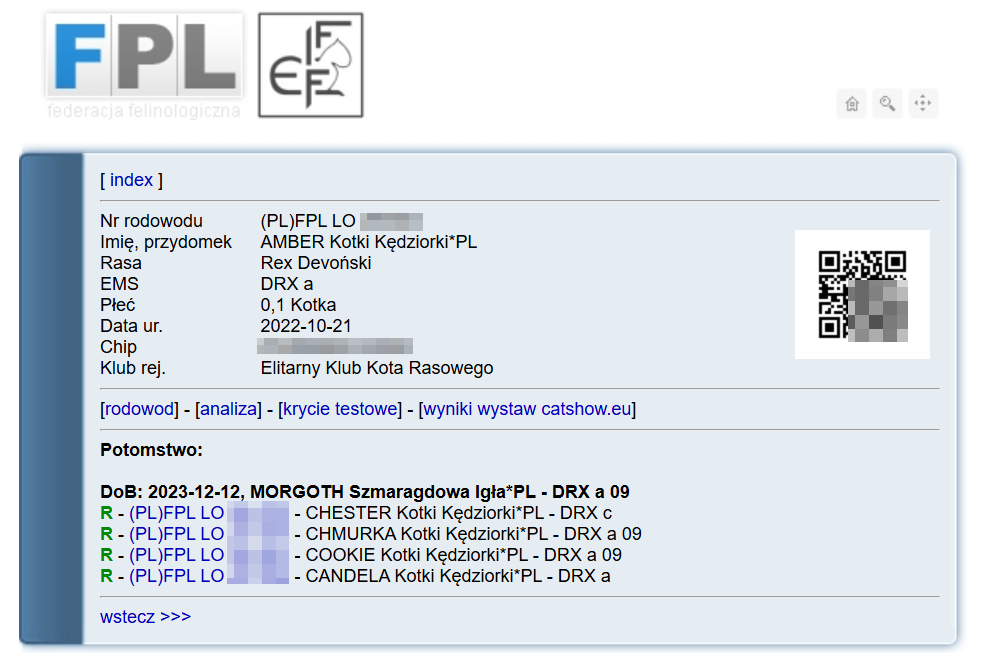
In the FPL online databaseanyone can check the pedigree of any cat (in the FPL organisation), i.e. its ancestors (5 generations back) but also its descendants (children), also an official the EMS color and sex.
Interestingly, two are also visible genetic coefficients (IC – the inbreeding coefficient, with an ideal value of 0% and below 3% as a very good result, it should not exceed 6%; AVK – the ancestor loss coefficient, with an ideal value of 100% and above 85% as a very good result).
For this it is enough just entering its name and the cattery name – try it yourself by entering e.g. „AMBER Kotki Kędziorki*PL” (you can enter only the name, and the system suggests various catteries with a cat of that name).
You will then get a result like below:
Checking the pedigree in the FPL database
It is the first level at which you can check any kitten in FPL.
Note: the litter must already be registered with FPL (which usually happens after chipping the kitten, when the breeder can register the litter) and be registered there.
Full pedigree check (only in FPL)
Full pedigree information can be confirmed using the FPL Pedigree Office search engine, providing the full identification details of the document – the full pedigree number (PL FPL …) and the serial number (S/N), which is known only to the owner.
In this full check you will receive many more details: full name, breed, the EMS color, sex, date of birth, chip number, the club it is registered in, also a QR code. On top of that a link to the pedigree, a full analysis of the pedigree (including relatedness, inbreeding, etc.), a test mating, show results.
And finally (if available) also all the offspring listed of a given cat – with details (including the father/mother) – with pedigree numbers, full names and with EMS colors.
Full information from the FPL Pedigree Office
Note: This second check can only be performed how the breeder collects the paper pedigree from FPL and this full identification number and serial number will already be available for it. But it is also possible to check this with us even BEFORE collecting the kitten.
Summary
As you can see – the pedigree is a very important document for a cat. It lets you identify it, be sure of its origin and confirm the legality of the cattery.
Remember to BEFORE buying a cat from a cattery to make sure whether you will receive a pedigree, which organisation will issue it (FPL, WCF, TICA) and whether you will get it in hand (in the original!) at the collection of the cat!
📢 Do you have questions about pedigrees or Devon Rex breeding? Write to us! 🐾😺
Interested in a Devon Rex?
If you are interested in a Devon Rex kitten from our cattery, then:
You can also follow us on Facebook, Instagram and TikTok – we also regularly publish lots of photos, videos, and information there. Like and follow our profiles to stay up to date with what’s happening with us 🙂
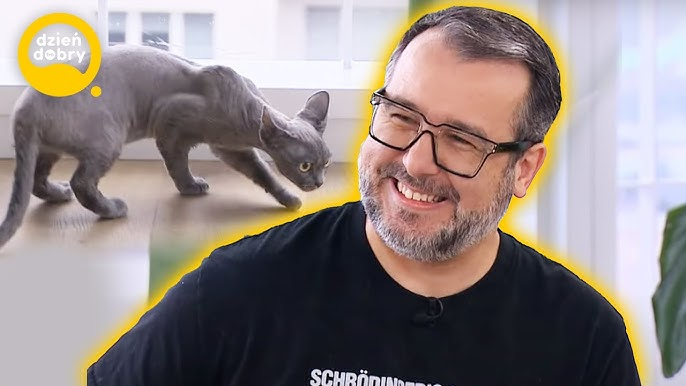
Devon Rexes are wonderful cats, as we say and write time and again. More and more of them are also appearing in interesting media coverage. On this page we want to gather a few interesting materials (it will be updated if something new and interesting comes up) about our breed. Here you'll find recordings (from traditional and online media) in which […] featured
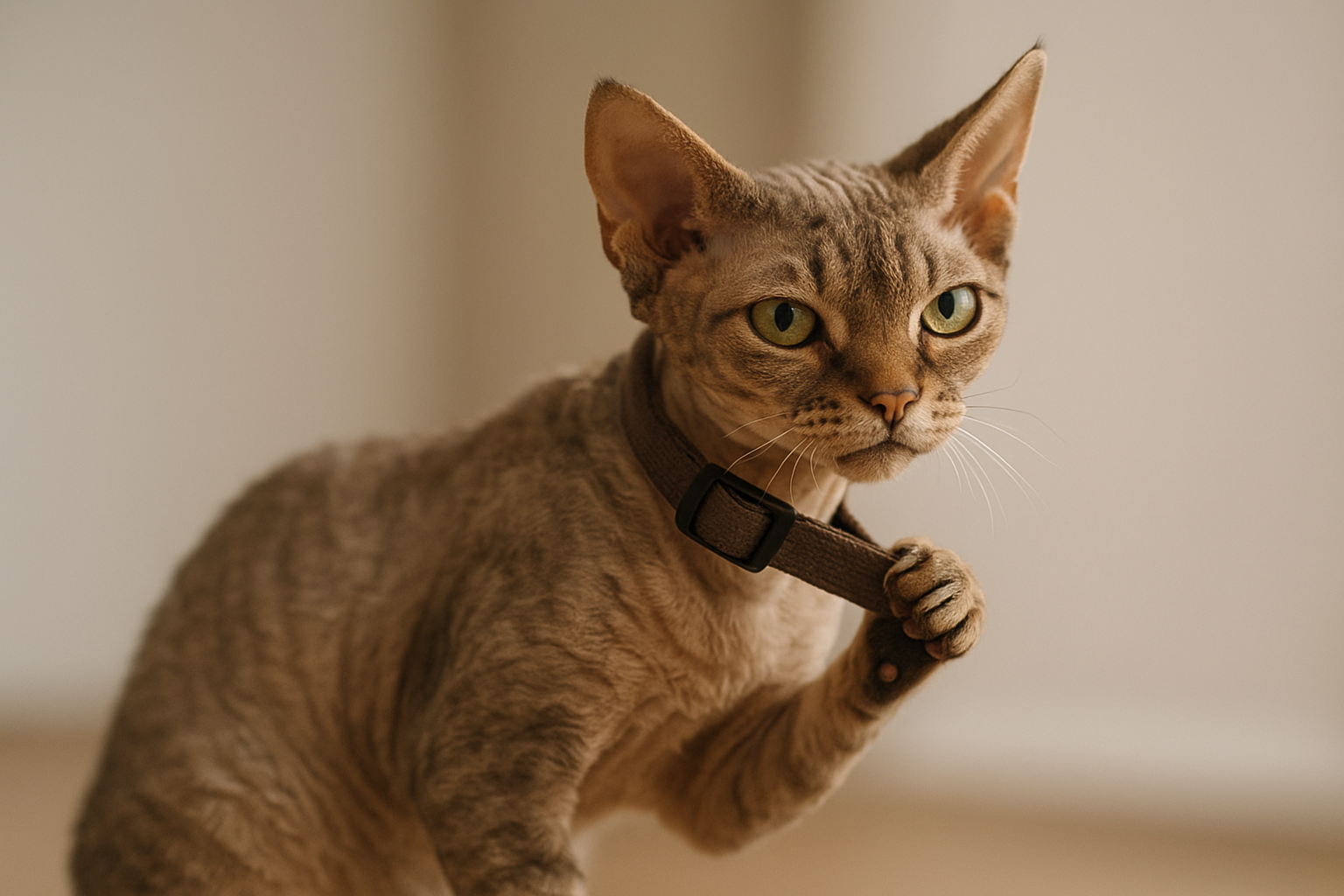
Collars on cats still stir emotions – especially when someone posts a photo of a cat with a small, „cute” strap around its neck. Unfortunately, what looks innocent is in practice often one of the most common and most dangerous items in a cat's „starter kit”. This guide was created to explain why collars on cats are risky, what consequences they can have, what […]
The first days in a new home are a big event – both for the cat and for its owner. See how to wisely introduce a cat to a new home, i.e. what „settling in” and socialisation with isolation are.