Socialisation with isolation / Adding another cat – how to wisely introduce a cat to a new home
The first days in a new home is a big event – both for the cat and for its owner.
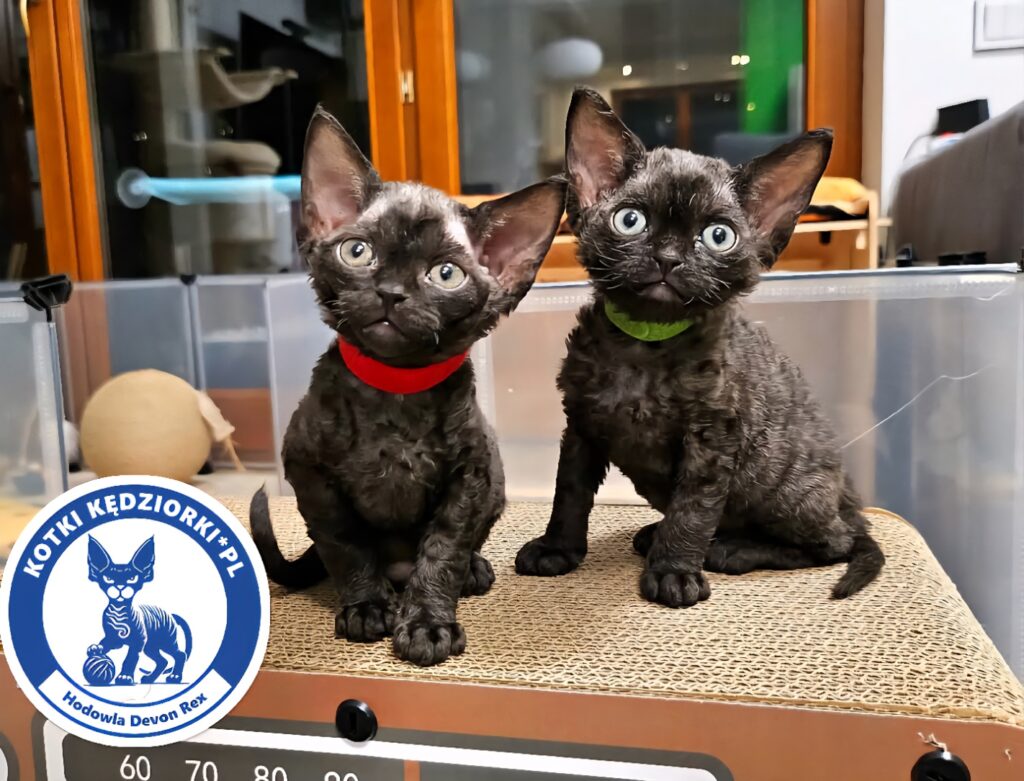
Even if we are talking about a perfectly socialised cat (such as our Devon Rexes from Kotki Kędziorki 😼), a change of surroundings is always an enormous amount of new stimuli, smells and sounds – that is of stress for the kitten.
And it is worth ensuring that everything goes smoothly – especially if there are already other animals at home.
What is socialization with isolation?
This is an approach that helps the cat acclimatise in the new place without unnecessary stress. The point is for the new household member to have time to get used to the surroundings in a safe, separated space – before it gets to know the rest of the household, if there are any (both human and animal).
This is not about isolation as punishment – it is rather a comfortable, calm transition zone. Thanks to this the cat has a chance to build a sense of security before it collides with all the rest of the new home reality.
In this zone the cat has a separate small, calm space (we usually suggest your bedroom), where it can safely acclimatise. Instead of immediately giving it access to the whole flat, we give it one room – its own their own safe world.
What must we take care of in such a room?
In such a room the following should be found (we can prepare this BEFORE the trip to collect the kitten):
a litter box (away from the bowls),
bowls with water and food,
a bed or a hideaway (e.g. a box with a blanket),
a scratching post or small shelf,
toys and materials for exploring scents.
And of course we remember about closing the door behind them when we come in and go out.
And now a very important matter, because we will act differently when I only have this one new kitten at home (scenario 1 below), and differently when we already have some other animals (scenario 2).
Scenario 1: A home without other animals
So the new cat goes to a home without other animals. In this case, socialization with isolation is usually not necessary* – as long as we are dealing with a well-socialised, brave and friendly cat… that is, exactly like our little Devons. 😊
Our cats (raised in a home full of stimuli, people and animals) in a new place often simply look around with curiosity, jump onto the windowsill, onto the bed, under the bed, check out the scratching post – and that is it feel at home. We have seen it many times – they enter a new empty home and behave as if they had lived there for a week! We almost always hear such comments from the new families 🩷
Do you know why this happens? Because socialization in our cattery is one of the key principles. Read the separate guide titled Cat socialization – 7 key elements in practice, and see how we actually carry out such socialisation in the cattery before we give you our little one.
Of course every cat is an individual – that is why it is worth ensuring a calm welcome, a few hideouts and giving it the possibility of exploring the space at its own pace. But there is no fear – it is usually a very gentle adaptation. And most often the same day the kitten is ready to explore the whole home 😼
*Note: If you bought a cat from another cattery, it is worth discussing this topic with that breeder. Maybe in their case, even with one cat entering an empty home – socialisation with isolation may be needed (e.g. for a few days).
Scenario 2: There are already other animals at home
Here the situation looks different. Even if the new cat is confident, cheerful and friendly – we cannot assume that the resident (i.e. the animal we already have at home) will also react with enthusiasm.
A new cat needs its own space, but resident also needs time to get used to the new situation. Without isolation there are often tensions, aggression or „silent stress” – which may later manifest itself in health and behavioural problems.
That is why in this case socialization with isolation is an absolute must.
A new cat should first go to a separate room, which we described above (with a litter box, bowls, a scratching post, a bed/blanket). There it can rest after the journey, get to know the smells of the new home and gain confidence. At the same time the resident can sense the new lodger through a closed door, which allows both sides to get used to the new situation.
Then comes gradual introduction and here are its key stages:
Isolation of the new cat – with separate resources and no contact with the resident cat.
Exchange of scents – e.g. by swapping blankets or toys.
Play through the gap in the door – building positive associations.
Swapping places – where the resident goes into a room, and the new cat explores the rest of the house
First controlled meetings – e.g. through an ajar door or a barrier/net.
Short supervised visits – with the possibility of escape and observing reactions.
Increasingly longer time together – when there are no signs of stress.
Isn't that too much trouble? NO. It an investment in the future. It is better to devote a few days to a calm introduction of the cat, than to spend months later solving problems.
Even if in the end they will sleep snuggled up in one blanket together, it is worth giving them this time. And there really is nothing to rush here, even if at first glance it seems that everything is supposedly OK.
And what if there's… a parrot at home? Or a dog? Or a guinea pig?
Yes, our charges have gone to really different homes – with dogs, parrots, hamsters, guinea pigs. Thanks to careful socialisation, most of them coped brilliantly with the new company.
But here too the rule applies: a careful and controlled introduction. Cats are curious (especially Devons!), but also sensitive – it is better to introduce such relationships step by step, under supervision and with full respect for the boundaries of both sides.
How does it look at our place?
At Kotki Kędziorki*PL we take great care to ensure that our kittens are ready for life in new homes. From the earliest weeks they have contact with people, sounds, children, guests and new things. Thanks to this they enter the world with great self-confidence – which greatly facilitates their adaptation.
At Kotki Kędziorki*PL we teach our kittens openness and trust, but at the same time we recommend to every new owner the introduction the isolation stage.
It is not just a safety element – it is the best gift you can give a cat to start with. With our support and tips this process is simple, and the effects – worth every day of patience.
Do you need more knowledge?
This is just our a short guide. When you collect a kitten from us – we will tell you more (be sure to tell us about all your animals, we usually ask about this at the very beginning even before the reservation, but maybe something has changed or you forgot something). And you will always be able to come back to us with questions!
We also do not want to duplicate the really good and detailed articles of experts, so if you want the topic of socialisation with isolation to explore more thoroughly, then we suggest a few additional articles by specialists (behaviourists) on this topic:
You can also follow us on Facebook, Instagram and TikTok – we also regularly publish lots of photos, videos, and information there. Like and follow our profiles to stay up to date with what’s happening with us 🙂
Learn the truth about the Devon Rex! We debunk 20 popular myths about these exceptional cats – from their supposed hypoallergenicity to grooming and behaviour requirements. Find out what life with a Devon is really like and what makes it the perfect companion for active owners.
Choosing the right way to feed your cat is one of the most important decisions every owner makes. Diet has a huge impact not only on physical health, but also on a cat's behaviour, wellbeing and lifespan. Feline diet is a topic surrounded by many myths and emotions (also among breeders). After all, every owner wants their cat to be healthy, […]
Here are the perfect accessories worth having for your Devon Rex! A list of 14 essential items – from scratching posts to beds – will ensure comfort, safety and entertainment for your cat. Thanks to these tips your Devon Rex will be happy, and you'll take better care of its needs every day.