What and how should you feed your cat? A guide to cat food
Choice the right way of feeding cat is one of the most important decisions every owner makes. Diet has a huge impact not only on physical health, but also on a cat's behaviour, wellbeing and lifespan.
A cat's diet is a topic around which many myths and emotions circulate (also among breeders). After all, every carer wants their cat to be healthy, to have beautiful fur and to be full of energy. But what is actually best to feed a cat?
Choosing between BARF, wet, dry or semi-moist foods can make your head spin. That's why we've prepared a short guide – based on knowledge and our experience as a breeder. In it we show what the main feeding options are – from the best to those that should only be a supplement – and what it looks like in our cattery Kotki Kędziorki*PL.
💡In short – How to choose the best method for your cat?
The best diet is the one that:
is complete (full-portion) and well-balanced,
has meat – a cat is an obligate carnivore, animal protein must be the main component of the diet
takes into account individual needs the cat (age, activity, health condition),
is accepted by the cat – because even the best food will not help if the pet does not touch it.
Let's also remember to to observe your cat – the fur, skin, body mass and energy level are the best indicators of whether the diet suits it.
All right, so now let us present the available options for feeding cats with a short discussion of them.
🥩 1. BARF – the most natural diet for a cat
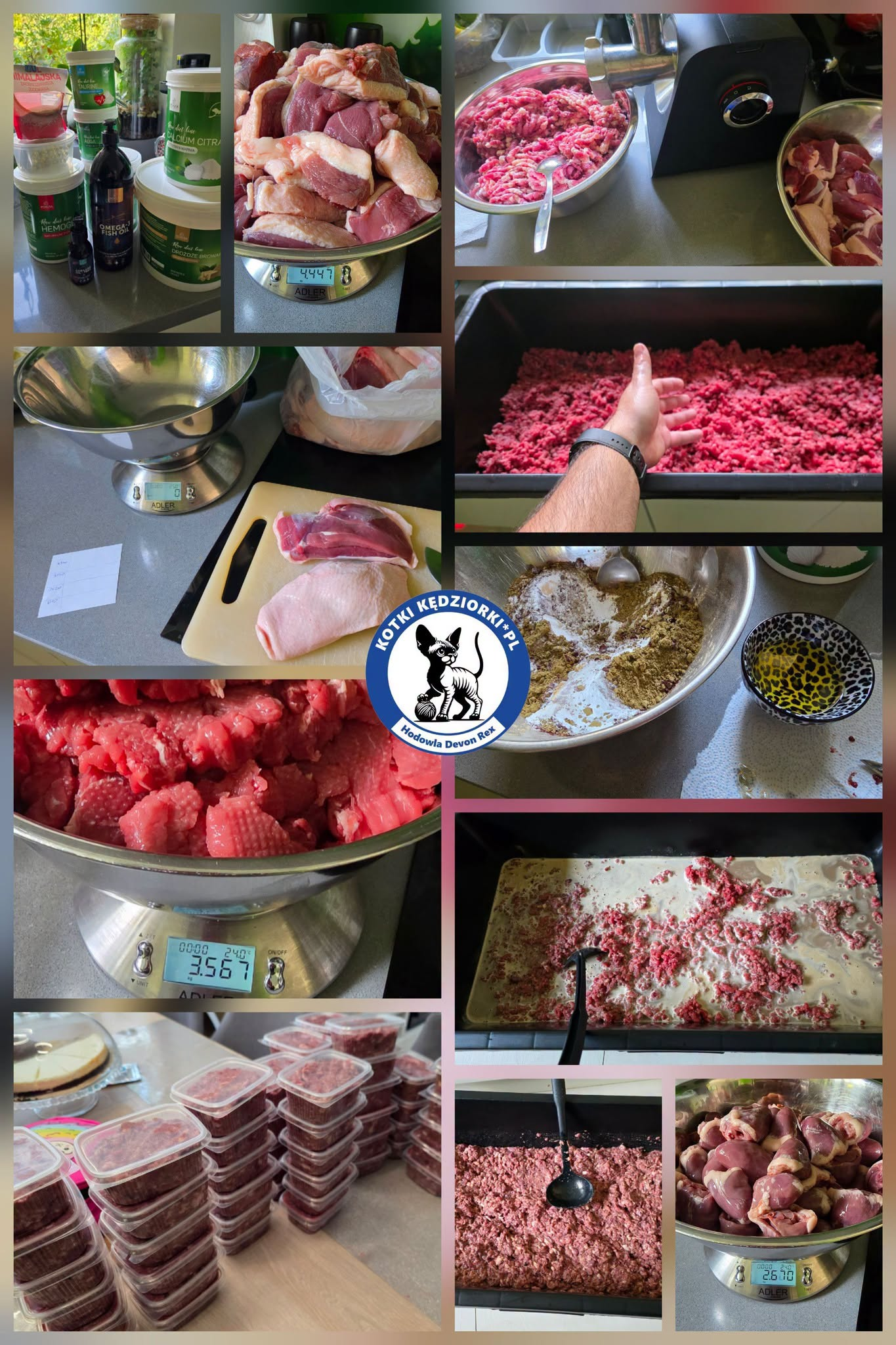
The BARF diet (Eng. Biologically Appropriate Raw Food) is based on raw meat, offal and appropriately selected supplements, which together recreate the composition of the natural food of a cat predator.
It is a diet that requires knowledge and precision – wrong proportions can lead to deficiencies or excesses. But a properly balanced BARF provides the cat with everything it needs – it is the most biologically compatible form of feeding.
➡️ W Kotki Kędziorki od 2026 roku przeszliśmy na karmienie BARF. Dzięki temu mamy pełną świadomość tego co podajemy kotu (mięso, które sami kupujemy, praktycznie brak dodatków), jest to bardzo naturalne dla kota surowe mięso, a my mamy mniej intensywne zapachy z kuwety (lub nawet ich brak). Możesz też przeczytać poradnik dedykowany BARF – czym jest, jak go robimy, itp.
🥫 2. Wet foods – a compromise between convenience and quality
Good quality wet foods are the most frequent choice of carers who want to provide their cat with a balanced and healthy diet without having to prepare the meals themselves.
A good wet food should contain a minimum of 60-70% meat, without grains, preservatives, artificial dyes and sugar. Wet food hydrates the body and relieves the kidneys – which is of great importance in the prevention of urinary tract diseases.
The advantages of wet foods are the high water content (important for kidney health), convenience and ease of serving, a wide choice of flavours, no need to prepare the meals yourself (as in the case of BARF).
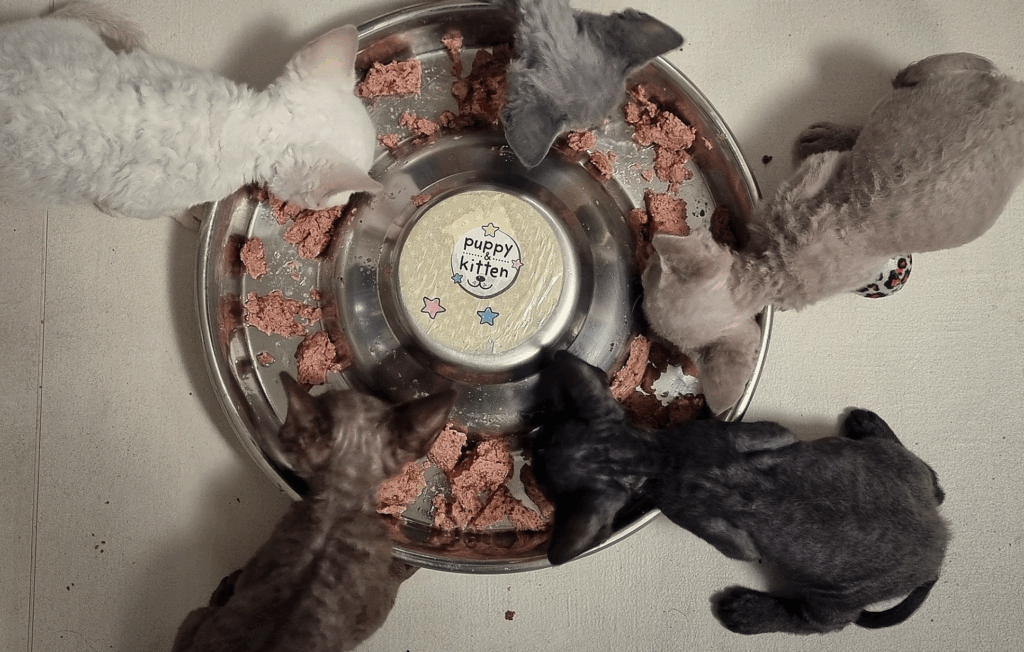
➡️ At Kotki Kędziorki we know that new Carers may find BARF feeding a challenge, so we also teach the little kittens to eat MjAMjAM or Wild Freedom wet food (high-meat, natural and with a stable, predictable composition). Thanks to this we know exactly what our cats eat, and we're sure they get everything they need.
🐾 3. Dry foods – convenience and a diet supplement
Although dry foods are the most popular on the market, their quality can vary greatly. Too large an amount of grains, vegetable fats and carbohydrates is something that a cat's biology does not need.
That is why dry foods should be treated as a supplement of the diet, not its foundation. The best dry foods are those grain-free, with a high meat content (minimum 60%) and a low amount of carbohydrates.
Important: If a cat eats mainly dry food, it must have constant access to fresh water.
➡️ In our cattery we use Farmina N&D Prime food – exclusively high-grade, grain-free and easily digestible. The kittens are taught to eat it, so new Carers can continue to use it, although we recommend BARF or possibly wet food.
🍗 4. Frozen or cooked meat – a homemade alternative
Some carers choose a compromise between BARF and ready-made foods, giving cats frozen meat (e.g. chicken, turkey or beef). The meat is frozen to get rid of parasites from it (it should be frozen for at least 3 days at a temperature below -21 degrees C).
This solution can be good, as long as you remember about diversity and supplementing deficiencies of vitamins and minerals, e.g. taurine. Cats are obligate carnivores – so every step towards a higher meat content in the diet works in their favour.
🧁 5. Supermarket and semi-moist foods – a poor choice
They are the least recommended option. Although it tempts with its price and smell, it often contains grains, dyes, fillers and sugars. Long-term feeding with such food can lead to obesity, kidney problems and diabetes.
We certainly we do NOT recommend foods popular in many stores (including supermarkets) of the Whiskas / Brit / Felix / Kitty / Sheba type, which are foods largely based on grains (with a small amount of meat), often have an unclear composition and a lot of sugar.
🍖 6. Treats and snacks – yes, but sensibly
Every carer likes to pamper their cat – and there is nothing wrong with that! Treats are a great way to build a bond, to teach simple behaviours or to create positive associations in a new home.
It is worth choosing snacks with a simple, meat-based composition – e.g. 100% dried meat, freeze-dried chicken or turkey bites, or possibly functional treats supporting the teeth, fur or immunity.
A good rule is that treats should not make up more than 10% of the daily calorie portion – then they really remain a „snack”, and not a second breakfast.
🍽 What feeding looks like in our cattery
In Kotki Kędziorki*PL we combine scientific knowledge, practice and observation of our cats.
We use feeding based on BARF, but we also teach the little kittens to eat high-meat wet food (MjAMjAM and Wild Freedom) and high-quality dry food (Farmina N&D Prime).
🧠 Summary
There is no single „ideal” diet for every cat – just as there is no single recipe for a perfect life with a cat. The most important thing is to understand its needs and look for the best possible solutions in the given conditions.
The most important thing is that the food is high in meat, balanced, free of grains and sugars – and so that the cat eats it willingly. It is worth choosing a way of feeding that combines biological suitability with practicality, because only then will it be possible to consistently take care of your purring companion's health every day.
In our cattery we try to combine practicality, health and quality, so that each of our cats starts a new life with good habits and a healthy appetite.
Interested in a Devon Rex?
If you are interested in a Devon Rex kitten from our cattery, then:
You can also follow us on Facebook, Instagram and TikTok – we also regularly publish lots of photos, videos, and information there. Like and follow our profiles to stay up to date with what’s happening with us 🙂
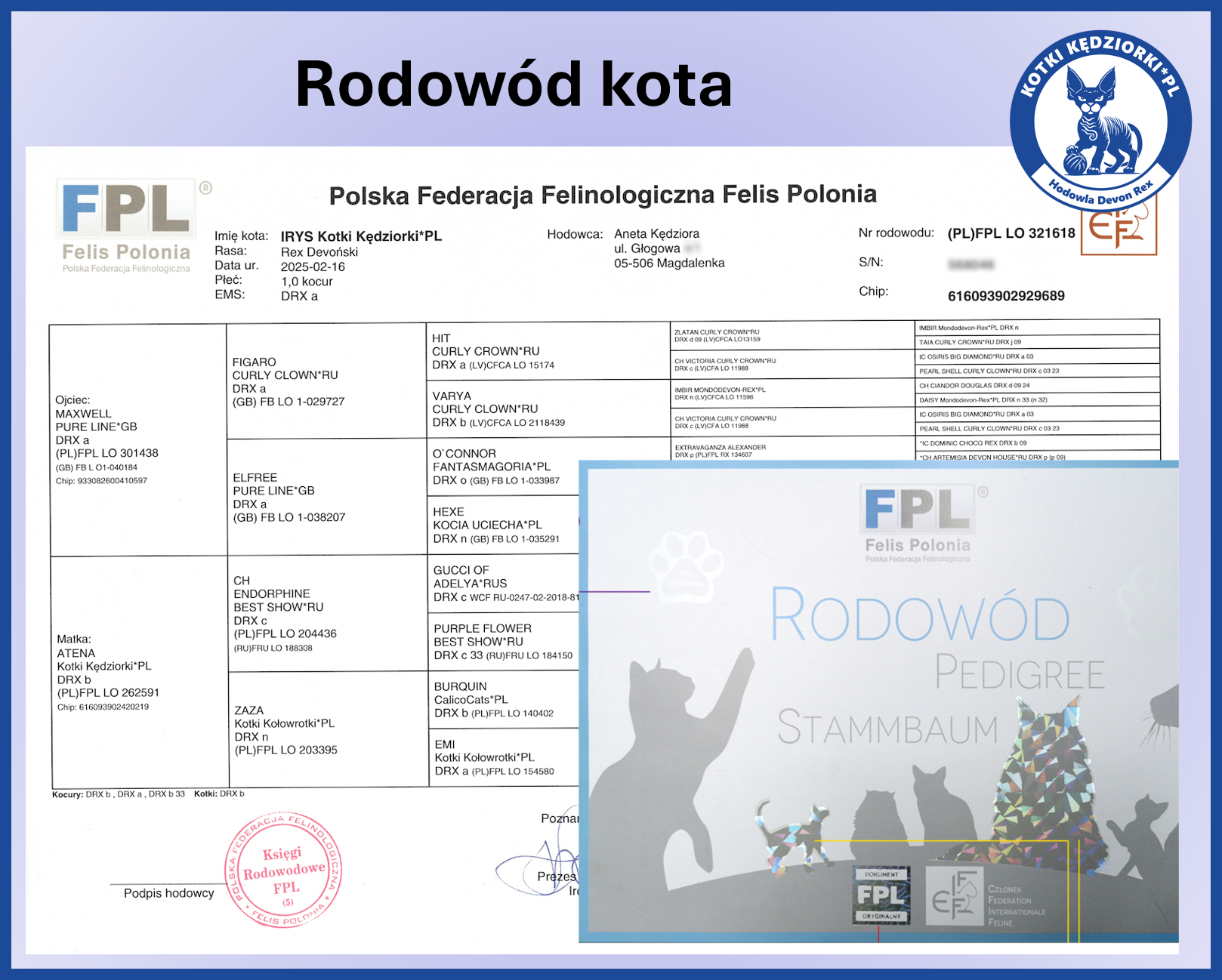
A Pedigree is an official document confirming the origin of a purebred cat. It is issued by recognized feline organizations and serves as a kind of “ID card” for the cat, containing information about its ancestors, breed, and cattery. There are NO purebred animals without a pedigree! Every purebred cat from a legal cattery should have a pedigree, and if you are buying a cat, make sure you will receive it, absolutely and without any extra conditions.
BARF to temat, który wcześniej czy później pojawia się chyba w życiu każdego bardziej świadomego opiekuna kota. Jedni słyszą o nim i myślą: „Kot powinien jeść mięso – to ma sens!”. Inni widzą listę suplementów, wagę kuchenną, kalkulator i kilkanaście różnych składników i zastanawiają się: „Ale po co sobie to wszystko komplikować?” 😄 Prawda jest […]