Devon Rex cats come in a great many color variants and everyone will surely find a kitten in their favorite color.
To to make it easier to determine cats' colors (both breeders and buyers), people started to use the EMS system (Easy Mind System).
We would like to explain what the deal is with colours (and these EMS codes). And we have two options for this:
For beginners – so as to know what the colours of Devons are and what the letters/digits mean
For advanced users – if you want to understand exactly what and how EMS describes
Devon colors for BEGINNERS
First we will try to explain the EMS code for laypeople and in the simplest possible language (so we apologise to the specialists for certain simplifications, and invite you to the advanced part further on the page).
The EMS code starts with a 3-letter abbreviation assigned to a given breed. For Devons this will be DRX.
Next after DRX you will see letters OR letters and digits (single or several groups). They specify very precisely the cat's color in many respects (colour as such, but also patterns, shades, but also eyes, etc.).
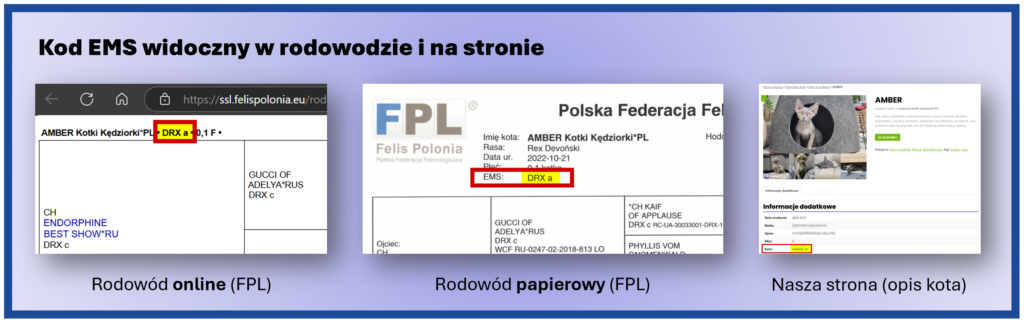
Ultimately you will see the EMS code both on the pedigrees as well as in the descriptions of our cats on the website.
Basic color variants
In very simple terms, you can find Devons in several main color varieties:
Solids – the cat has only one color the whole body (solid)
Points – the cat is „white/light”, but has color on the ears, muzzle, paws, and tail
Patched – the cat has some main color + has white spots/patches/color in various places
Tabbies – the cat has some main color + has stripes (like a tiger/leopard)
Tortoiseshells – the cat has some main color + additionally the color red
These are the main varieties, but of course there can be cats that are a mix of them. Plus there are a few details which, for simplicity, we will not discuss in this part (e.g. shading of the hair).
Now below we will describe each variety and we will show on drawings what it looks like + we will give examples of cats from our cattery in a given colour variety (the links will take you to a given cat's page, where you can see more of its photos).
1. Solid
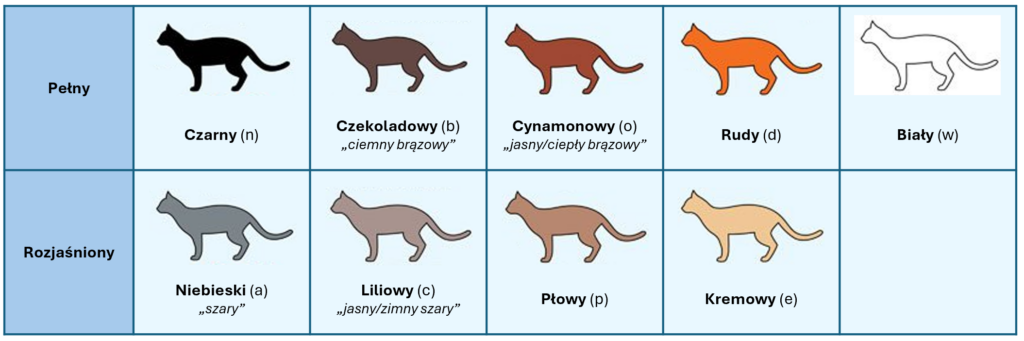
Solid cats have a uniform color over the whole body. They can be in 9 base colors, which have the following letter designations:
black (n) and lighter blue (a)
chocolate (b) and lighter lilac (c)
cinnamon (o) and lighter fawn (p)
red (d) and lighter cream (e)
white (w)
Note: Laypeople often describe a cat's colour as they see it – that's why a cat that is officially blue is in fact sometimes called and described as „grey”. Chocolate looks like „dark brown”, and cinnamon like „light brown”, lilac is a bit „cream / light grey”, etc.
Note: The cat white (unlike a point or a bicolour cat, which we'll get to in a moment) is a cat that has no other colour on its body (it's either an albino or a cat without colour – which, interestingly, can have coloured offspring). If any other colour appears on its body, then it's no longer a white cat (in that case see point and bicolour cats).
Example: Our solid cats are e.g. Atena (DRX b – chocolate), Amber (DRX a – blue), Giga (DRX c – lilac).
2. Point
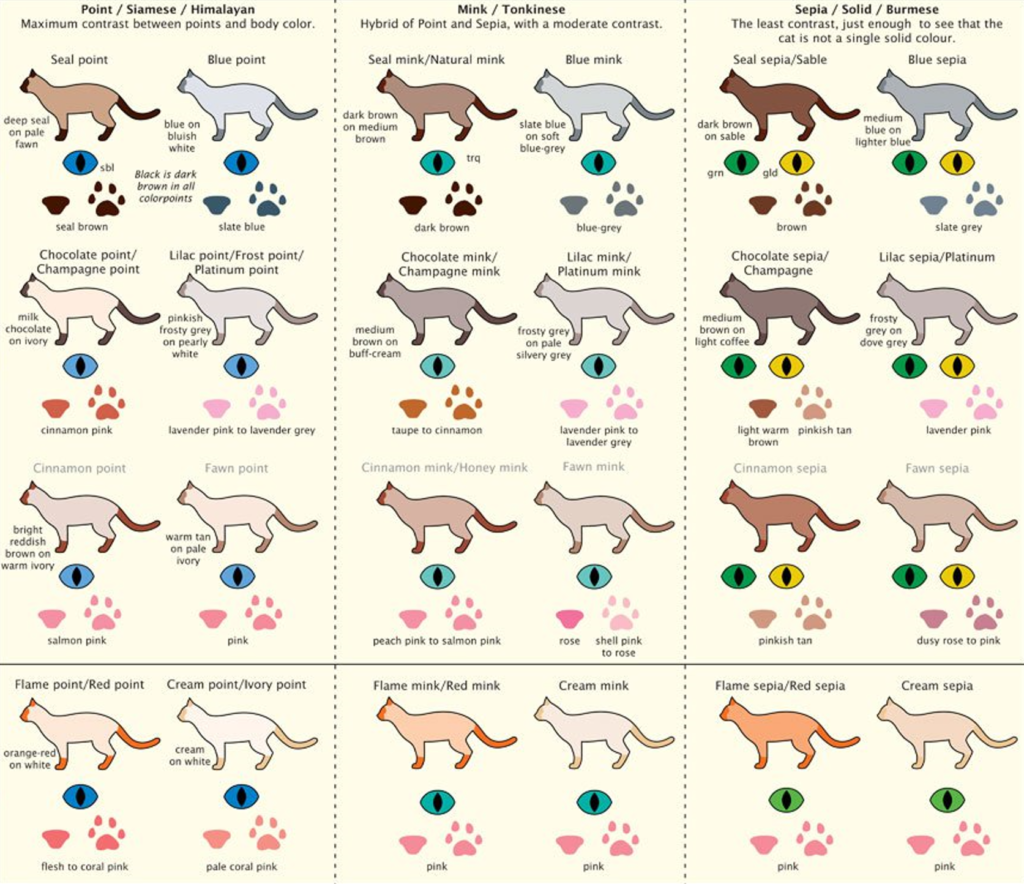
Point cats look like white/light, but have one of the above solid colours in 4 specific and very characteristic places – on the paws, muzzle, ears and tail.
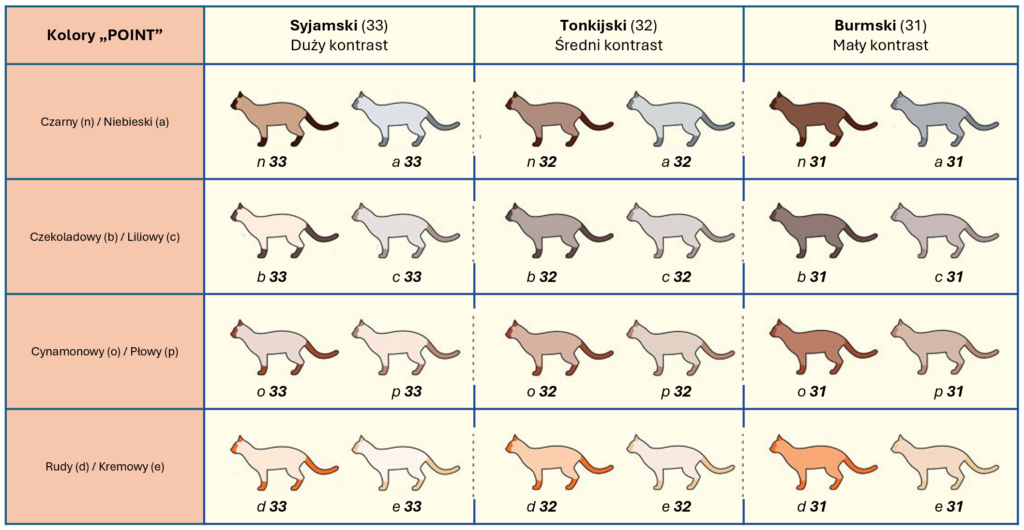
In pointed cats there are 3 varieties depending on the contrast (between the white and those places with colour), and they have numeric designations starting with the digit 3:
Siamese (33) – maximum contrast (an almost white/light cat with colours in these 4 places)
Tonkinese (32) – medium contrast
Burmese (31) – the lowest contrast (almost like a solid)
The EMS code of a point cat consists of the base colour (a letter) and these two digits with a 3 in front.
Example: Our pointed cats are e.g. Faraday (DRX o 33 – cinnamon Siamese point), H-Wenus (DRX a 33 – blue Siamese point), or Bajka (DRX c 33 – lilac Siamese point).
3. Patched
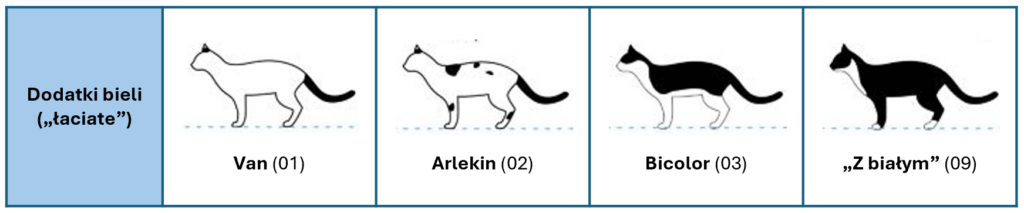
A „patched” cat has some main colour, but also has an addition of white color (spots/patches or a large part of the body). Depending on amount of this white colour it has its 4 possible designations with a 0 in front:
van (01) – white is >95% (colour only in the area of the ears and on the tail)
harlequin (02) – white is > 80% (like van + additional patches on the body and legs)
bicolor (03) – white makes up about 50% of the body
„with white” (09) – the white is < 40% (these may also be tiny spots)
Note: In Devons only these 4 designations of „patching” are possible (and probably the most numerous are those 09 „with an unspecified amount of white”), but in other breeds there are more of them.
The EMS code of a „patched” cat consists of the base colour (a letter) and these two digits with a 0 in front.
Example: Our Diament is DRX c 09 (lilac with white), Chmurka is DRX a 09 (blue with white), Cookie is DRX a 09 (blue with white).
Fun fact: Can you see the difference between a white cat (w), a point cat (3x) and a patched cat (0x)? A white one (w) must be entirely white. A point (especially Siamese 33) may „seem” white, but it has those distinct colors in specific places (paws, muzzle, ears, tail). A patched cat, (especially van 01) may seem like a white cat or a point, but pay attention where it has this white and where it does not. And to make it even more interesting, take a look at our Einstein, which is at the same time a point cat and a „patched” one (it has the code DRX n 09 33) – how can you tell? He could not be a „pure” point, because he had white paws (i.e. white in the place where points have a specific solid colour).
4. Tabby
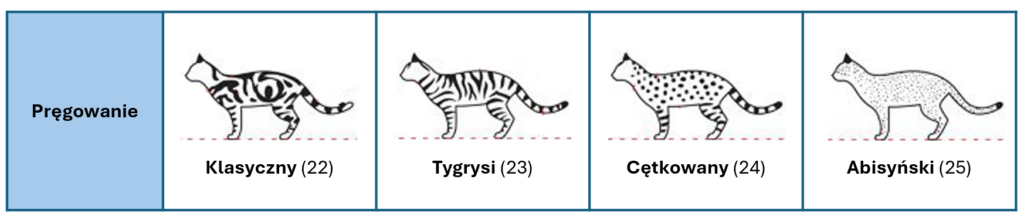
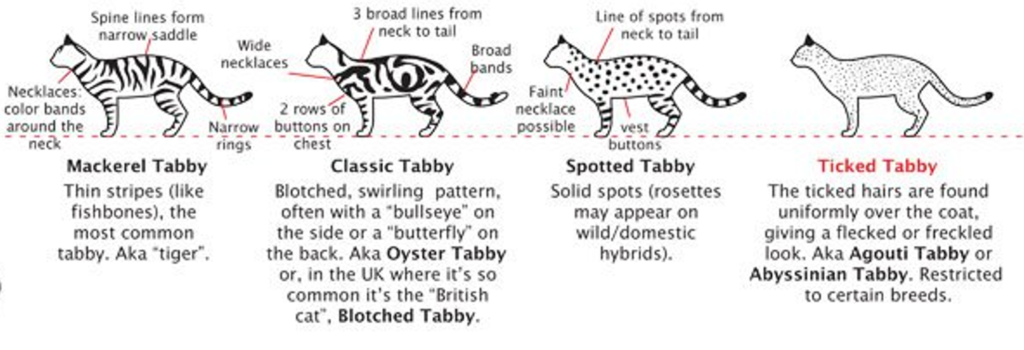
Cats can have, besides the base color, also a pattern / design on the coat in the form of stripes, spots or other patterns. It then looks e.g. like the fur of a leopard or a tiger. Depending on the type of pattern, 5 options are possible, which are designated with a digit starting from 2:
classic (22) – the pattern forms closed circles, resembling butterfly wings
mackerel (23) – parallel stripes – like on a tiger's fur
spotted (24) – the pattern forms spots/dots – like a leopard
ticked/Abyssinian (25) – broken up, no visible striping/patterns
undetermined (21) – when none of the 4 patterns above fits
The EMS code of a tabby cat consists of the base colour (a letter) and these two digits with a 2 in front.
Example: We have not yet had a tabby kitten in our cattery 🙂
5. Tortoiseshells
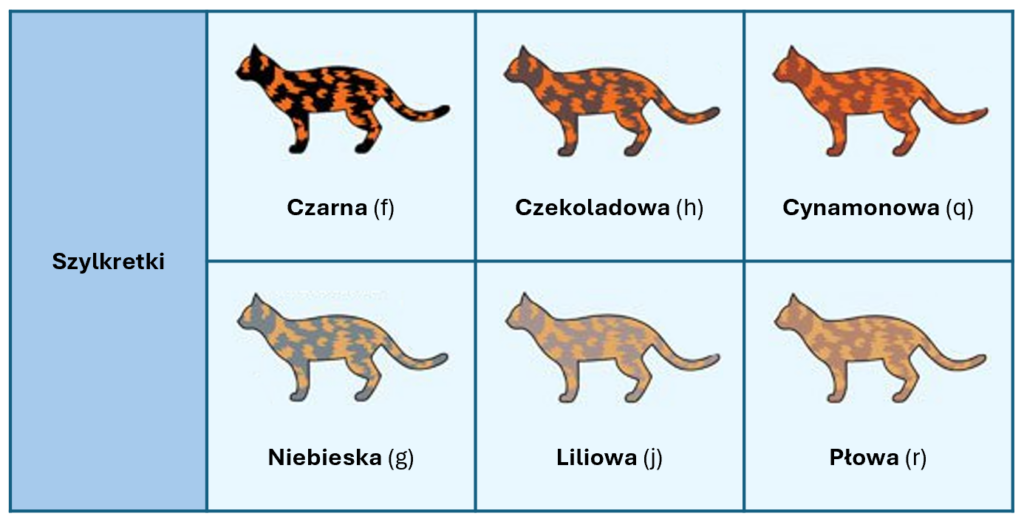
Tortoiseshells are cats that have red colour mixed with one of the main colours. And depending on the main colour there is a different the letter designation:
black tortoiseshell (f) and lighter blue tortoiseshell (g)
chocolate tortoiseshell (h) and lighter lilac tortoiseshell (j)
cinnamon tortoiseshell (q) and lighter fawn tortoiseshell (r)
Interestingly tortoiseshells are only females (tortoiseshell toms have a genetic defect and are infertile).
Example: Deli is DRX f 09 (black tortoiseshell with white) and Didi is DRX h 09 (a chocolate tortoiseshell with white). As you can see here there is a double combination – of tortoiseshell and „patching” (because both girls also had white as an additional colour).
Summary
As you can see, it is quite a simple and intuitive way of describing colors. You just have to remember that Devon Rex cats can also occur in a mixture of these elements – e.g. patched tortoiseshells, tabby with white, etc. But we will not complicate this any further 🙂
For a beginner it is probably still a lot of information. So here you can finish reading. Unless, that is, you want to find out more – then you can move on to the ADVANCED part (below).
However, with the explanation above you already know the basic colour options of Devons and should be able to:
to determine the EMS color the cat when you see it* and
based on the DRX xxx notation to know what color it really is.
*Fun fact: Determining a cat's colour with the EMS code isn't always so easy (especially in the first days/weeks of a cat's life, and especially for point cats, which can change colour over time, even up to 2 years). It takes some experience, and even then it may not be done perfectly (we too are sometimes not 100% sure and occasionally ask fellow breeders for their opinion). Either way, the colour must be determined by the breeder when registering the cat for a pedigree (and entering the specific EMS code – it is also included in our contracts). After the fact, you can also go to a show, where there is a special category called „colour determination”, where the judges (specialists) can actually confirm the cat's colour from the pedigree. It may also happen that the judges change the official colour of the cat on the pedigree, because they decide the breeder may have made a mistake!
Devon colors for the ADVANCED
If you want to find out much more about colours, their detailed designations and all the color variants – now here is a description for you. Note – it will be longer and more detailed and technical.
What is an EMS code?
It is a system created by the International Feline Federation (FIFe) for the easy identification of pedigree cats.
The EMS code is a combination of letters and numbers that describes the cat's external features and covers such elements as: breed, colour and its distribution on the body, eye colours, types of tail and ears. The full description is available on the FIFe website.
The beginning of the code denotes the breed and is written in capital letters (the Devon Rex breed in EMS is the letters DRX), the further lower-case letters specify the dominant colour, and the numbers the patterns, varieties or distribution of the fur colours. Additionally, for some breeds a designation of the eye colour, tail length or ear shape is introduced.
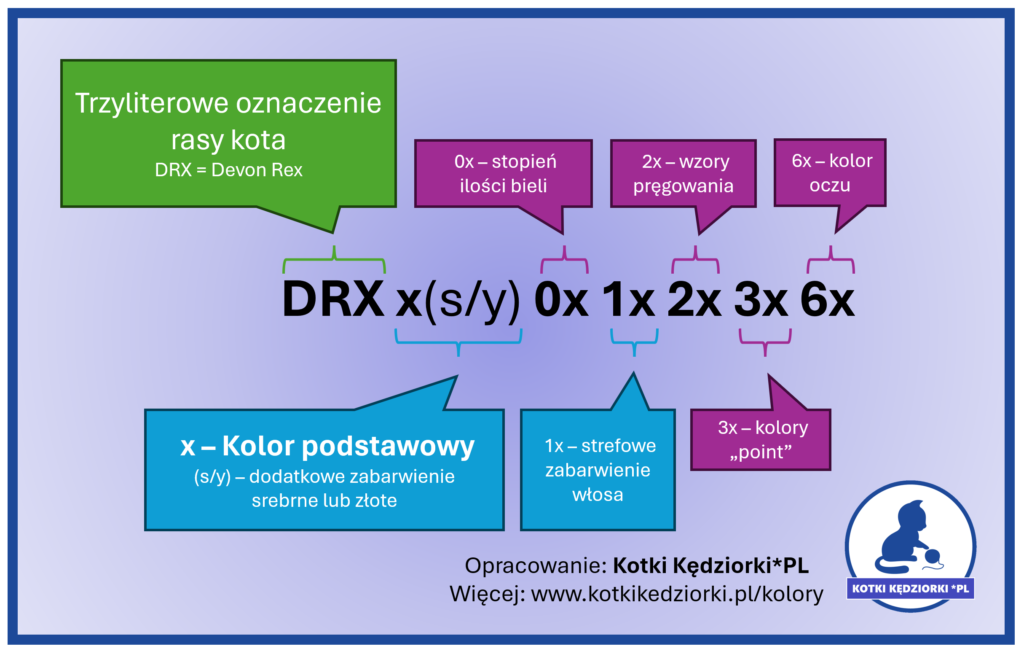
The EMS code (for the Devon Rex breed!) consists of the elements: DRX x(s/y) 0x 1x 2x 3x 6x
The basic EMS code for a Devon Rex cat
Note: the list below covers those EMS elements that are possible specifically for the Devon Rex breed. In other breeds additional elements may appear in the notation (e.g. the type of tail, ears or type of fur).
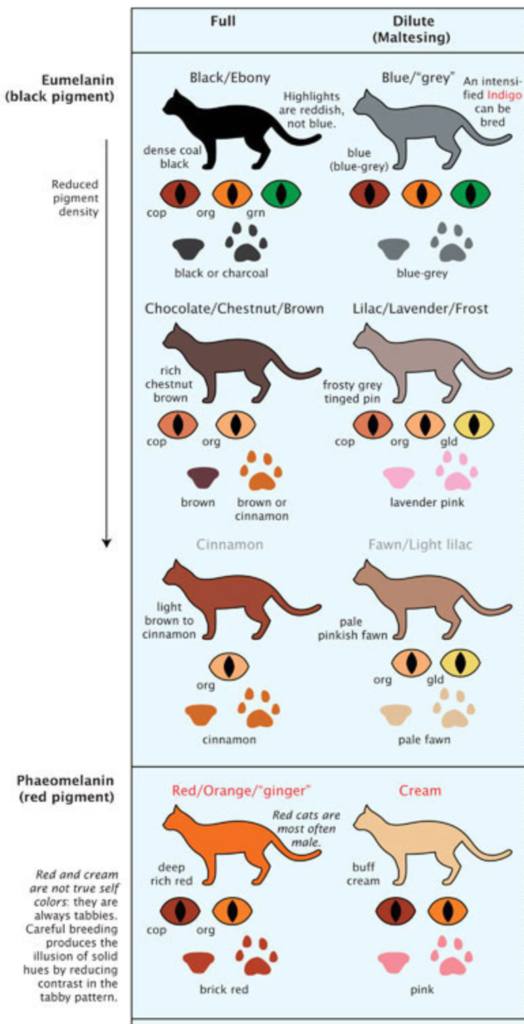
Note: The author of the graphics included in the content below is Joumana Medlej, who agreed to their use (more informatio below).
x – Coat color (base)
It can be said that it is 8 base colors Devon Rex cats (6 in black-pigmented colours and an additional 2 red-pigmented colours). To this is added „tortoiseshell color” (in 6 basic variants) and finally white color.
Onto this are then overlaid certain varieties, patterns or additions of white. We invite you to get acquainted with the details of this classification.
Note: It happens that the cat's final coloring may change up to even the 2nd year of life. This is especially visible in “point” cats, but other initial colours can also change slightly. Interestingly, there are several factors when cats can change colour: temperature (here again especially points), sun, nutrition, age and illness.
Black-pigmented (eumelanin)
n – black / black
a – blue („grey”) / blue
b – chocolate / chocolate
c – lilac / lilac
o – cinnamon / cinnamon
p – fawn / fawn (light lilac)
Red-pigmented (pheomelanin)
d – red / red
e – cream / cream
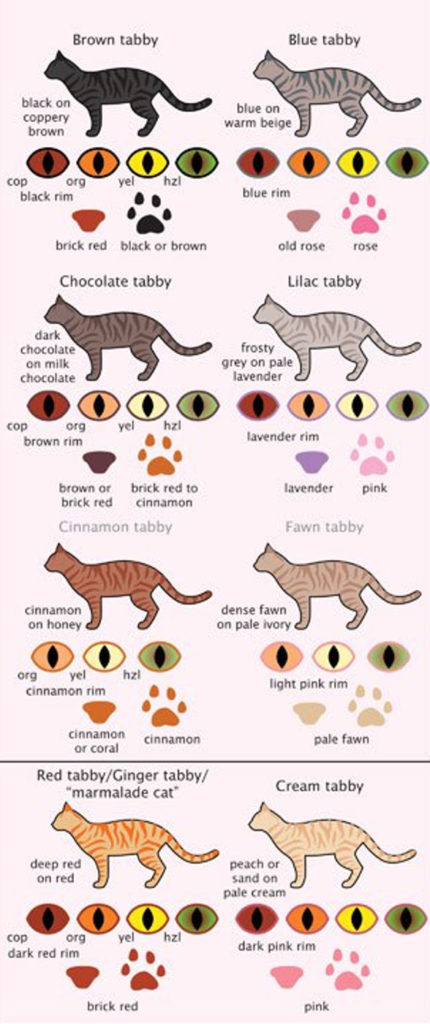
Note: These two colours (d and e) are not entirely solid colours, they always appear tabby (tabbies, described below in section 2x). Appropriate combining of genes can make it an illusion of a solid colour (reducing the contrast in the tabby pattern).
Full/single colors (solid)
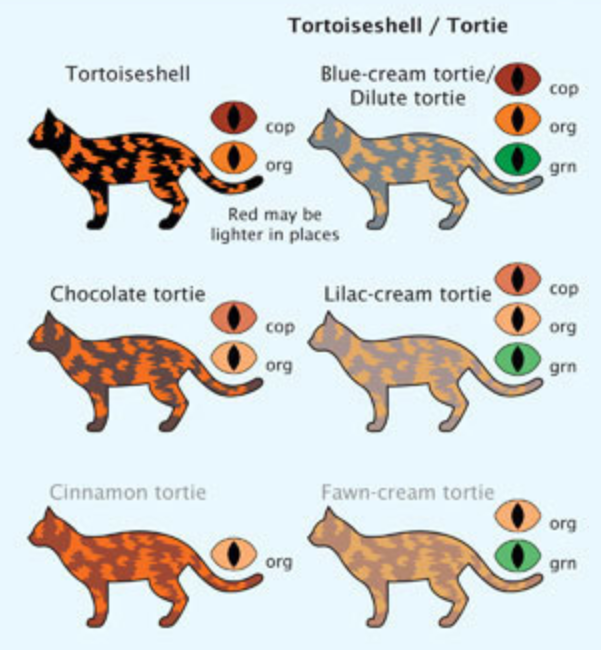
Tortoiseshells (two-pigmented)
f – black tortoiseshell / tortie (tortoiseshell)
g – blue tortoiseshell / blue-cream tortie (dilute tortie)
h – chocolate tortoiseshell / chocolate tortie
j – lilac tortoiseshell / lilac-cream tortie
q – cinnamon tortoiseshell / cinnamon tortie
r – fawn tortoiseshell / fawn-cream tortie
Note: Tortoiseshells are usually females. A male tortoiseshell has a genetic defect and will be infertile.
Tortoiseshell colors (tortie)
No color
w – white / white
Note 1: The color white occurs very rarely. It is either albino (a complete lack of pigment) or a white cat, which in fact is not a colour but a suppression of the colour genes. Because of this, and interestingly, white cats (not albinos) can have coloured kittens. There's a very high chance that white cats will have different-coloured eyes (the technical name is heterochromia).
Note 2: There are also often kittens that look almost „white” (the vast majority of their body is white) with a distinct colour on the nose, paws, ears and tail. But then their colour officially is NOT white, but indicates the base colour (above) plus an addition called „point” (described below).
x(s/y) – Additional coat colorings (silver and gold)
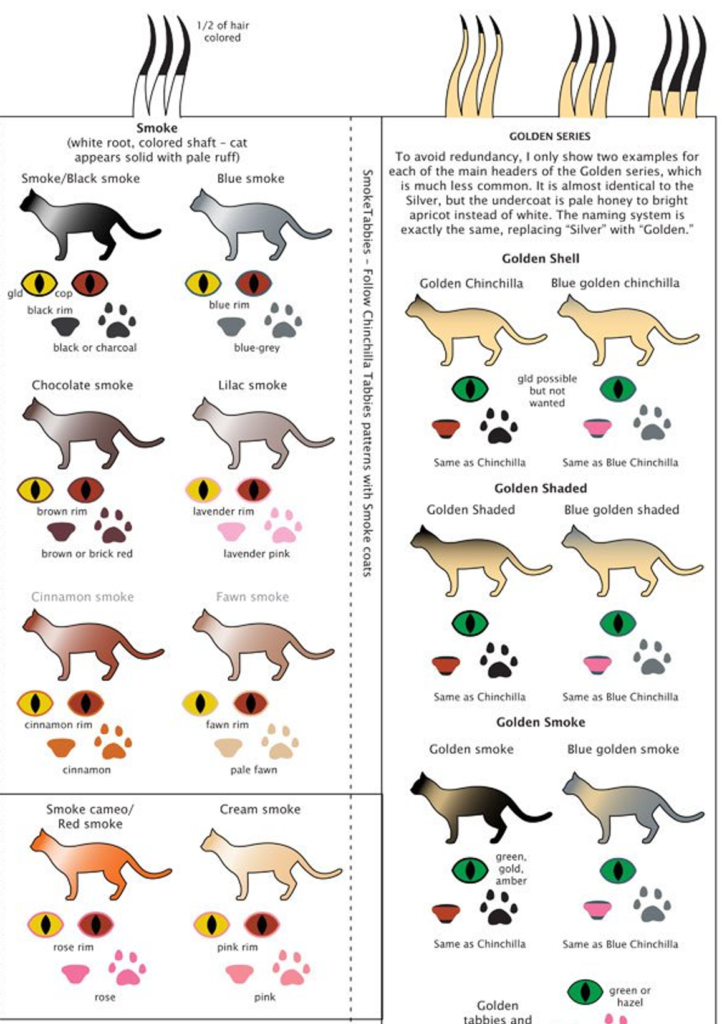
In some cats each the hair is only partially colored (in the upper part of the hair, the base colour), and in the lower part there is devoid of pigment – and it can look white (Silver) or yellowish (Golden).
To distinguish such a colouring, to the letter denoting the base colour we add one of two distinguishing features:
s – silver, smoke / silver, smoke
y – golden, golden smoke / golden, golden smoke
However, the suffix s or y occurs always with a base color, because it always occurs at the tip of the hair.
Note: We often call such cats smoke, however it is a bit more complicated, because the coloured section of the hair can vary and the above designate the s/y colour for us if the hair is colored in more than 50%/half. If the colouring is smaller, the terms shaded and shell appear (11 and 12 – described in the section „Zonal colouring of the hair” below).
Silver (smoke) and golden (golden) colorations.
0x – Degrees of the amount of white (amount of white)
We specify it only if the cat has additional elements of white color to the main base colour. Most often they are described by laymen as „patched” cats.
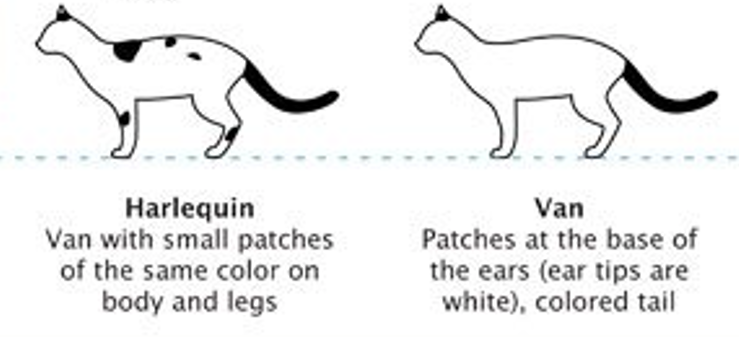
01 – van (white + color only around the ears and on the tail)
02 – harlequin (van + with additional patches of the same colour on the body and legs)
03 – two-color / bicolor (approx. 50% white)
09 – so-called undefined amount of white (usually less than 40%)
Harlequin and Van
1x – Zonal hair coloring (tipped colors)
Just as we described in the Silver/Gold section – a cat's hairs may be partially coloured (at the tips of the hair). If more than half of the hair is in the base colour, then we only use the Silver/Gold colours.
But if the base coloring is less than 50%, then an additional color designation appears:
11 – shaded (1/4 of the hair at its end is coloured)
12 – chinchilla, shell (1/8 of the hair at its end is coloured)
Zoned coloring of the hair
Note: Of course these additional designations (11 and 12) ALWAYS appear in combination with the Silver or Gold colour (s/y), because the remaining part of the hair (the lower part) will always be in one of these two colours.
2x – Tabby patterns (tabby patterns)
Apart from the classic base colours or „patches” cats can also have the „pattern” on the coat in the form of stripes or spots.
21 – undefined tabby pattern
22 – classic / blotched (the pattern forms closed circles, resembling a butterfly's wings)
23 – mackerel / mackerel (parallel stripes – like on a tiger's fur)
24 – spotted / spotted (the pattern forms spots, dots – like a leopard)
Often cats point (especially 33 – Siamese) are described (by laymen) as „white”, because in most of them the dominant colouring is a light colour or one very close to white.
But their main and dominant colour is still the one specified in the first point (base colours). And this colour is located on the paws, nose, ears and tail.
This is exactly the contrast between the whole body and certain specific points, which we call point.
Point color varieties:
31 – Burmese (sepia / solid) – the smallest contrast between the base colour (almost solid)
32 – Tonkinese (mink / hybrid) – medium contrast
33 – Siamese (point / himalayan) – maximum contrast (a distinct point)
Fun fact: Kittens are usually born very light, but with age the cat will become darker and darker in these „point” areas (in the vast majority of cases). It may also happen that in the warm months (summer) the cat has a less intense colouring, or is darker in the cold months (winter). Point is a form of albinism, in which the warmer regions of the body are darker – hence also those possible changes over the year.
Point color variants + base colors
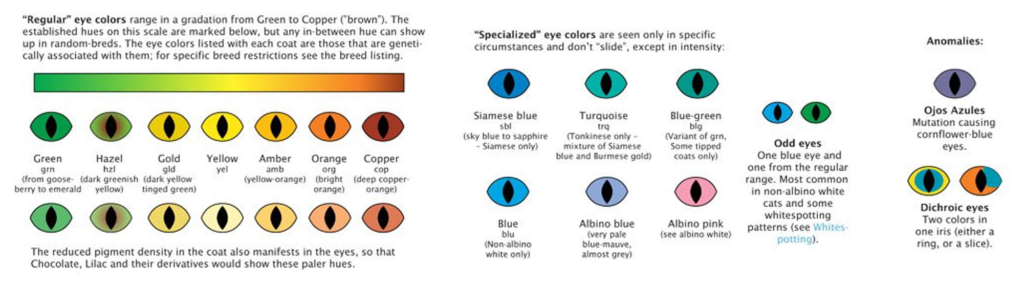
6x – Eye color (eye colour)
Eye colours are not always specified for Devon Rexes, because there are several situations when they have to be used, but also several when they are not used.
Eye color codes must be used when:
the cat is white („w”) OR
when it is NOT a point, but has large amounts of white (01, 02) OR
when it is NOT a point, but has blue eyes (61).
Eye color codes are NOT used when the cat is a bicolour (03) or with an unspecified amount of white (09).
Eye color codes:
61 – blue / deep blue
62 – orange / copper or deep orange
63 – odd-eyed / odd eyed
64 – green / green
If a cat is „w” (white), then apart from the colours listed above (61-64) you can also use additional colors (but they are used ONLY for white cats):
Fun fact: For the first roughly 10 days of life, cats have completely closed eyes (they mainly use smell to recognise their mother and siblings). During the first weeks of life (similarly to people) their eyes are blue or blue-grey (it is the result of a lack of pigment, melanin, in the irises). Then around the 5th-6th week (as a result of the accumulation of melanin) the colour becomes more intense. However, only around 5-6 months of age, they take on their proper color – blue, orange/copper or green.
Classic and specific eye colors. Note: Not all colors occur in the Devon Rex.
Full graphic from the descriptions above
As we mentioned earlier – in the above descriptions we used an excellent graphic prepared by Joumana Medlej, who agreed to the use of this graphic on our Kotki Kędziorki*PL website (all copyrights belong to her and it may not be distributed without her consent – in whole or in parts!).
You can find the full-resolution graphic on her website: http://cedarseed.com/portfolio/housecat-colors/, where you can also order yourself a large poster, a canvas print or even a duvet with this graphic 🙂
The graphic does not describe only Devon Rexes (so it shows many more colours, colourings and varieties), but we selected those elements that concern only our cat breed.
Now you are already almost an expert in cat colouring, especially of the Devon Rex breed 🙂 We hope we have cleared up a bit of various doubts related to colours.
In the information about the kittens in our litters, of course we use these colors and we also use them when you get in touch with us or when we publish something on the website or Social Media.
Also exactly such colors will appear in the pedigrees of our kittens.
If you still have any questions – feel free to get in touch with us (the Contact page), we will try to help.
Note: We do not guarantee the completeness, currency or 100% certainty of these descriptions. They are the result of our knowledge, experience and many other articles on the subject (which sometimes contain discrepancies). We've tried to convey this knowledge as accurately as possible – if, however, you have any comments or doubts, write to us so we can improve this description.
Appendix – Other articles about colors
We also decided to gather other places online that describe cat colours (sometimes from a slightly different perspective).
Anna Sara Gawrońska (from the Jaga*PL cattery) wrote a series of posts in a Facebook group about colours, where she focused on the genetic basis of colors. Even though it is genetics, these articles are written in very accessible language – we recommend them!
Appendix – Recognized Devon Rex colors according to FIFe
Below you will find an overview of Devon Rex colors, which are officially recognized by FIFe. During shows they are judged precisely in these individual groups.
Group I – Solid (also smoke/silver)
Black / Blue / Chocolate / Lilac / Cinnamon / Fawn DRX n/a/b/c/o/p
Black / Blue / Chocolate / Lilac / Cinnamon / Fawn smoke DRX n/a/b/c/o/p s
Group II – Solid with white
Black / Blue / Chocolate / Lilac / Cinnamon / Fawn with white DRX n/a/b/c/o/p 01/02/03/09
Black / Blue / Chocolate / Lilac / Cinnamon / Fawn smoke with white DRX n/a/b/c/o/p s 01/02/03/09