Choosing a cattery – 9 tips for future owners on how to choose a good cat cattery


Buying a pedigree cat is a very important decision, which will affect your life for years, which is why it is worth devoting time to the right choice of cattery. How to avoid kitten mills or places which, although legal, do not provide cats with appropriate conditions?

Here is 9 key tips, which will help you make an informed and safe decision.

1. Legality of the cattery

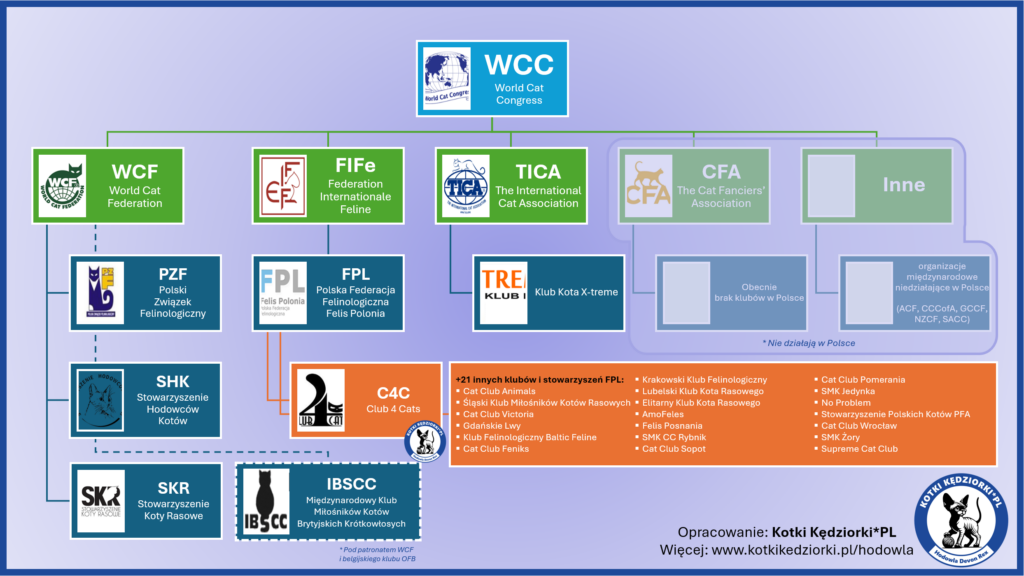
A good cattery should be registered in one of the feline organisations operating under the auspices of World Cat Congress (WCC), e.g. FIFe/FPL, TICA, WCF.

Look for information (or ask the breeder outright) which organisation their cattery belongs to and check whether it really is one within the WCC.

Organisations belonging to the WCC, which can issue legal and recognised pedigrees.

If it is a cattery in some club/association but OUTSIDE FIFe/FPL, TICA or WCF – here too be careful, because due to the imperfections of the act, they too can release „their pedigrees„, which however mean nothing in the legal cat world.

Additionally, if a „breeder” offers “pedigree cats without pedigrees” – run away. A true pedigree cat always has documented origin. And the breeder belongs to clubs/organisations affiliated precisely with the WCC.

Our cattery

We are affiliated with Klubie Club 4 Cats Olsztyn, which belongs to FPL/FIFe, and this belongs to WCC. You can read more about our pedigrees and organizations on the subpage about our cattery. There you will also find the registration details of our cattery.

2. Check the cat's documentation

Every pedigree cat should have:

📜 Pedigree – confirming its origin (necessarily from the WCC – FPL/WCF/TICA)
📘 A health booklet – with up-to-date vaccinations and dewormings.
📍 Chip – essential for identification (important: implanted in the cat and not „given in hand”).

An honest breeder will have no problem showing documents (including of the kittens' parents) and their health tests. Make sure that when collecting the cat you will actually receive the pedigree in hand, and not that it will be conditional in the contract on some additional conditions.

Additionally, be sure to ask the breeder specifically about a cat SALES CONTRACT and ask for its sharing BEFORE the purchase or even before your decision to buy. If the breeder doesn't have such a contract or doesn't want to share it in advance – think twice about whether you really want to choose this cattery, because you may later have problems pursuing any of your rights (because there's no trace that the cat was sold to you).

As for the chip – it is important that the chip was implanted by the breeder (at the vet's), and not to get the chip into your own hand. If you're given the chip in your hand, then first of all you have to implant it yourself later (an additional expense), but more importantly – you have no certainty that the cat you collected is a pedigree cat! Make sure the chip is in the cat and that the number matches the pedigree (you can check this at any vet).

Our cattery

We write information about the pedigree, chip, health record very openly on the page of our cattery. We also show the contract template right at the very beginning (even before the reservation!), and we're open to potential changes to it. Our pedigrees are issued by FPL/FIFe. And every cat leaving our cattery has a full health record book (with vaccinations, dewormings and information about neutering) and of course has a chip implanted, additionally already registered by us with Safe Animals.

3. The cats' health

Zdrowie kotów to jedna z ważniejszych kwestii przy podejmowaniu decyzji o wyborze hodowli. Niestety znamy wiele przykładów, kiedy ktoś wybierał kota i hodowlę bez zwracania na to uwagi, aby potem mieć duże problemy, częste wizyty u weterynarza lub nawet leczenie poważnych chorób.

When choosing a cattery, it is worth checking:

Healthy appearance of the cats – clean eyes, nose and ears, shiny coat, no signs of disease.
Tests of the kittens' parents – zapytajcie o testy genetyczne i zdrowotne (np. na CMS, HCM, PKD, FeLV, FIV).
Vaccinations and dewormings – kittens should be fully vaccinated before being rehomed.
Neutering – a responsible breeder should hand over cats already neutered.

As for the healthy appearance of the cats – there are two options – photos and a visit to the cattery (the second of these will be covered in point 4). Ask the breeder for photos of your kittens, ideally from different moments of its life (when it was tiny or a bit bigger), see what they look like and how they present themselves. If the photos are blurry, maybe the breeder wants to hide something. If they don't want to send them to you (or send 1 or 2 photos), that's also not a very good sign.

As for neutering, then the one done at the cattery is (despite the additional costs for the breeder!) much better – the cat has less stress, the new owner doesn't have to do it themselves (looking for the right clinic, then stressing about the procedure and finally caring for the cat after neutering), the cat recovers in a place it knows and with its mum. So choose catteries that do this on site before handing over the kitten! Current research and expert opinions say that kittens as young as two months can already be neutered.

Be sure to also check whether, at the time of handover the kitten is more than 14 weeks old (based on the date of birth of the litter / pedigree). Kittens released earlier, even though they may seem much sweeter (and you certainly cannot wait for them!), are not ready at their early weaning from their mother and siblings, because socialisation should last at least until the 14th week. Those given away and collected earlier may later have behavioral problems but also health ones. Besides, organisations within the WCC do not allow younger kittens to be released. So a good cattery with basic knowledge of feline behaviour understands that extra time at the cattery (even though it's always an additional cost for the breeder!) will pay off in the kitten's future. 

Our cattery

In our cattery we take exceptional care of the cats' health. We are under the care of a specialist round-the-clock clinic right next to our home. We always test the cats' parents for FIV and FeLV.

In our cattery there has NEVER BEEN ringworm, FIP (feline infectious peritonitis), FIV (the feline equivalent of human HIV), parasitic diseases (giardia, toxoplasmosis, tapeworms, roundworms); none of our cats have ever had cat flu (caused by the FHV-1 and FCV viruses), feline leukemia (caused by the FeLV virus), feline panleukopenia (caused by the FPV virus), chlamydia, or rabies.

We also post lots of photos of our kittens on the website and Social Media, and we keep in very good contact with the new parents from the start – sending lots of photos, recorded videos and informing them about the little ones' condition.

Our kittens leave the cattery at 15-16 weeks, they are very heavily socialised, and are of course also neutered (in the purchase price).

4. The cattery's reputation – check the reviews!

Before you decide to buy, look for reviews about the cattery.

Enter the cattery's name in Google or on Facebook and forums and groups devoted to a given breed – and see for yourself what opinions appear about it. See the detailed guide „How and where to look for reviews of a cat cattery – 5 places to check

Additionally it is worth asking other owners who have already bought a cat from a given breeder – reliable catteries have nothing to hide, and even often boast about where their kittens have found a new home.

Here you have to watch out for one thing – there are, unfortunately, legal catteries that sell sick cats (often very knowingly). We know such examples too, from families who later bought cats from us. But if you start precisely by reading reviews, they should be easy to spot + you can do what we describe in the last (9th) point of this guide.

Our cattery

And what do people say about Kotki Kędziorki*PL? 🙂 We encourage you to read for yourself – here you will find reviews of Kotki Kędziorki on Google and reviews of Kotki Kędziorki on Facebook. There are statements from families who bought kittens from us – see for yourselves what they write in the context of our cattery.

5. Assess the breeder's approach

A good breeder will not sell a cat to just anyone. The poor one will simply want to sell the cat to anyone as long as it is quick…

A good breeder should to ask questions about the conditions you will provide for the animal, about your approach to animals, about what your expectations are, what you like and what you do not tolerate, should ask who the cat will live with (with a family, children, other cats or animals). If they do not ask such questions, then perhaps they sell cats indiscriminately and to just anyone…

The breeder should also inform you about the specifics of the breed and its requirements. About this what it expects from a new home, how they imagine future communication.

It is also worth noting whether gladly answers your questions – if they avoid difficult topics, that is a bad sign. If they answer curtly, then maybe they do not have knowledge about cats. If you feel that they want to end the meeting/conversation as quickly as possible, that also does not speak well of them.

By the way – you too should not start conversations by asking only about the price (more on that in point 8)… Tell us more about yourself, especially if you have already chosen a particular cattery (write/tell us why you would like a kitten specifically from them!), tell us what experience you have with animals, what your family is like (are you on your own, with children, with other animals), what you are looking for and what you expect.

Our cattery

It is a bit hard to write about oneself here, so we simply encourage you to contact us and talking with us. We like to talk about cats, our cattery and to answer all your questions! But we also very much like to hear who you are and what you expect from such a little cat.

6. Compare prices – beware of cats that are too cheap!

The costs of running a good cattery are high – they include:

🏠 Creating suitable breeding conditions (space, equipment)
🍖 High-quality food and proper care for the kittens and mother
💰 Mating with a carefully chosen tom
🍼 Care for the pregnant queen and the kittens
💉 Medical care: vaccinations, deworming, chipping
🧑‍🎓 Continuous development and gaining knowledge (at training courses, participation in shows)
⏱️ The breeder's work and time (conversations, contact before and after purchase)
✂️ Neutering (should be done before the cat is rehomed)
🧰 A rich starter kit for the little one

If you find kittens much cheaper than at other breeders, it may mean cutting corners on each of these elements above. And the worst is when it is cutting corners on their health, care and socialisation (e.g. not spending time with them and keeping them in small enclosed rooms).

Besides, Devon Rexes live 15-20 years and believe me, buying a cat is one of the smaller costs you will incur over these 15 years of its life with you.

Note: It sometimes happens that catteries (including ours) may have adult retired breeding cats for paid adoption. Their price is then lower (most often related to the cost of neutering and preparing the cat for adoption), but then it is worth reading about the details and conditions of such an adoption.

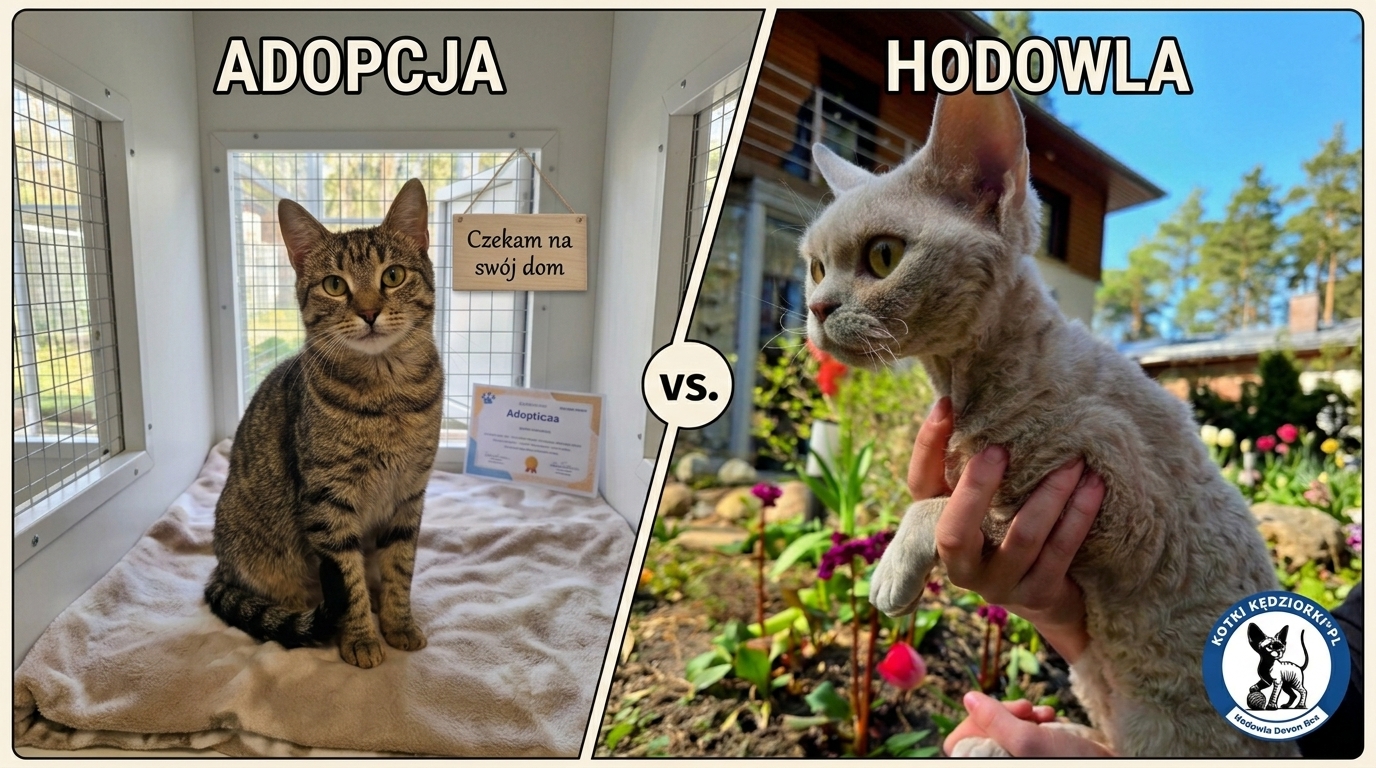
And finally – if you cannot afford to buy a Devon from a legal and good cattery – think about adoption from a shelter or foundation (instead of supporting backyard breeders).

Our cattery

We do not have the lowest prices among Devon catteries, we do not want to compete on that. But we also do not make a living from the cattery and do not have to think about how to sell the most cats.

We allocate the funds to developing the cattery and investing in cat things – cat walkways, scratching posts, toys, beds, space. We give them the best quality food, we take care of their health (the cats', the mums' and the kittens'), and we train ourselves too. Neutering and a rich starter kit are included in our price. We also don't sell cats to just anyone – we do everything to be sure we've found them the best possible home.

7. Visiting the cattery (and collecting the cat)

Visiting the cattery before making a decision to buy is a very important matter! After all, we are choosing a friend for many years, so it is worth devoting even an hour or two, and sometimes a day or two for travel, if we live further away.

On site you will see, in what conditions the cats live and how they behave.

It is then worth paying attention to:

Behavior – cats should be social, curious about the world and not afraid of people.
Conditions at the cattery – clean, fresh air, access to light and space to play.
Freedom – cats should move freely around the home, not sit in cages their whole life.
The presence of the mother and siblings – during the visit not only the chosen kitten should be present, but also its mum and (if possible) its siblings.

If such a visit is not possible (because you cannot make the trip OR there are also good catteries that do not want visits at all for reasons of cattery safety), then also ask about the possibility of a video call and showing the cattery remotely (after all, nowadays we have Teams, WhatsApp, Messenger).

If you arrange a visit – it is important that the kitten's mother and its siblings were present (if it has one). If the breeder brings the kitten to the living room from another place in the house and only lets you see that one, let us consider what the reason for this might be. If the cats run away at the sight of a person, it may mean that they do not have daily contact with them.

It may happen, however, that some particular cat is more shy on first contact and may not let a stranger pet it, but rather not all of them! It's worth choosing a cattery that has sociable animals and kittens eager to interact with people. Even if they don't jump onto your lap right away, they won't hide and will happily and fearlessly play or eat a treat you offer. It should be clear that the cats know the breeder well and trust them, and the breeder themselves is able to say a lot about each of them!

Picking up the cat should also take place at the cattery, and not „at a petrol station”, „in a car park” or „in front of a house”. In Poland there is a legal ban on selling animals outside their place of breeding. An exception may be a situation where you yourselves ask the breeder to bring the cat to your home — but remember that this may involve additional costs, and we generally don't recommend it.

Our cattery

We we allow the possibility of visiting our cattery and Devon Rex lovers are always welcome guests in our home. It has happened that families living several hundred kilometres from us visited us.

Here, however, it is also worth remembering that in the case of our cattery, for the safety of our kittens, we do not want cat tourism and viewing a cattery just for the sake of viewing (because „the children want to pet the kittens” or whether someone „just wants to check whether they are allergic").

So we allow visits only after reservation (non-binding). Additionally, visits are only possible once the kittens are vaccinated (around 10 weeks) and at the entrance we will ask you to wash and disinfect your hands.

We encourage you to contact us in order to agree on the details and arrange a meeting.

Our kittens are in 99% of cases collected at our home/cattery. The only exceptions are when the buyers themselves wanted us to deliver them to their home or the kittens were going abroad with a transport company (but we can count those on the fingers of one hand).

8. Check the cattery's transparency

A reputable cattery usually runs a website or is actively active in social media. It should publish information about kittens, photos even films, contact details, as well as opinions from previous buyers.

Yes, there can be good catteries that do not have this, but we do nevertheless suggest look for those who share honestly and openly with such information. Creating a website today is a small outlay compared to running a good cattery.

Avoid catteries that have only listings on sales portals (OLX, Allegro or others). Remember too that under Polish law cats cannot be sold at auctions!

You should find some information about the cattery on Google (just enter its name) and be able to to confirm its existence in a given club/federation belonging to the WCC. Some clubs have lists of catteries on their websites (divided by breed or voivodeship). These are also good places to start the search. 

If the cattery there are NO traces on the internet – it is worth wondering why!

Our cattery

You are now on the website of our cattery and we hope you like it and find a lot of information here. We write as transparently as possible. We show our litters, all our cats, by each cat we write where it went and if we have an opinion from the new family then we add it too (see e.g. Einstein, Heweliusz, or Finezja), we write very precisely what the process of buying a cat looks like. We are also very active online – on FacebookInstagram and TikTok – there too we regularly publish many photos, videos and information.

9. Seek the community's opinion

Breeders often know each other, but there is also a large group of Devon fans in Poland – if you have doubts, ask about a given cattery on the Facebook groups devoted to the breed. Often at that point the owners of kittens who have already bought a kitten from a given cattery speak up – sometimes these are great reviews, and sometimes downright warnings straight out against a given cattery (selling e.g. cats sick with FIP).

In the case of Devon Rexes you will find a large community e.g. in the group Devon Rex – my love, numbering over 13 thousand members.

It is better to devote more time to searching and checking, than to later face the health or behavioural problems of an animal. And we have had families come to us who had very poor experiences with OTHER catteries (and spent e.g. 10-20 thousand zlotys on care for the cat, because it was sick with FIP)…

Our cattery

We are not afraid of opinions about us. We always take care of the new families of our cats, we are always available to them. If you only feel like it – ask about Kotki Kędziorki*PL e.g. on the largest Polish Devon Rex group on Facebook.

Recently (in February 2025) someone on this group asked „Does anyone have a Devon from the Kotki Kędziorki cattery? Any opinions?„, so you can read for yourselves over 50 replies on this topic 🙂 By all means, you can also ask about it yourselves.

Summary

We have described quite a bit of this for you! But we hope that thanks to this it will be easier for you to make the decision of choosing the right cattery.

Choosing a good cattery is the key to having a healthy, happy cat. Remember to check the legality of the cattery, the conditions in which the cats live, the breeder's approach and the kittens' documentation.

We also have one more interesting guide for you: What questions should you ask a breeder BEFORE buying a cat? 10 key questions!

We will be very happy to answer many of your questions!

Interested in a Devon Rex?

If you are interested in a Devon Rex kitten from our cattery, then:

  1. read about our Kotki Kędziorki*PL cattery,
  2. see which kittens we currently have available (or which ones we have placed in new homes)),
  3. read a short article about kitten availability in our cattery
  4. see how you can buy a kitten from us 🙂

You can also follow us on Facebook, Instagram and TikTok – we also regularly publish lots of photos, videos, and information there. Like and follow our profiles to stay up to date with what’s happening with us 🙂

If you have any questions, please contact us!

Tags: , ,

Share: facebook.com