Early neutering in cats (around 14 weeks of age) – facts, safety, and why it is standard in our cattery
Recently on one of the Devon groups a question appeared that comes back regularly:
„Good morning, I am getting a kitten from a cattery and you say that you recommend neutering after the sixth month of life and will not neuter when they are 14 weeks old. I have come across different opinions, so I would like to clear up my doubts.”
Under the post a multitude of replies from breeders appeared, who wrote clearly: early neutering is today a standard in many responsible catteries.
And indeed – we too neuter our kittens before release (around 14 weeks) and have for years been very glad of this solution.
Unfortunately, comments also appeared along the lines of:
„Breeders do this only so that others cannot make money on breeding cats”.
This is not only untrue, but also a considerable misunderstanding of the topic. Early neutering is not a „blockage” – it is above all a health, behavioral and responsibility tool, which serves the cat and the new family.
In this guide we explain, what early neutering really is, what science says and why we use it.
What is early neutering?
Early neutering (early spay/neuter) means a procedure performed before reaching sexual maturity, usually:
after the 7-8th week of life
most often between 12 and 16 weeks
definitely before 5-6 months
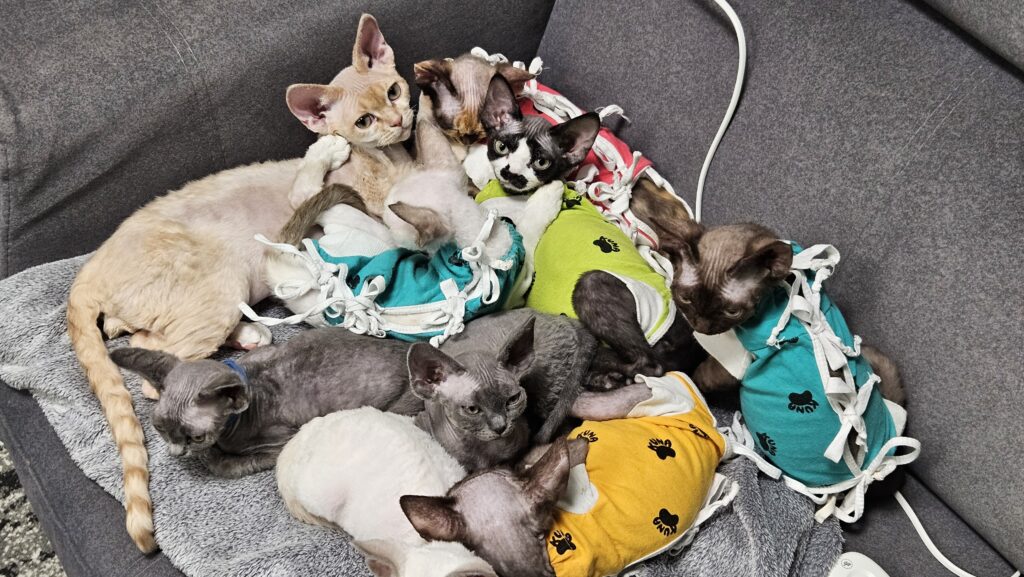
In our cattery we usually perform it at around the 14th week, that is, when the kitten is already stable, well developed, healthy (after dewormings, vaccinations and chipping) and ready to change homes.
Is early neutering safe?
Yes – and this is very well documented today.
Contemporary research and veterinary organisations confirm that with a correctly performed procedure:
the risk of complications is no greater than with neutering at the age of 6-8 months
recovery in kittens is often much faster
the body copes very well with healing
Early neutering has for years been a standard, among others in: the USA, Canada, Australia, animal welfare organisations and shelters and many pedigree catteries around the world.
More and more experts in Europe support it too, especially in the context of domestic and „pet” breeding cats.
The biggest benefits: the cat's health
Early neutering means that the cat does not enter the full stage of hormonal maturation, which carries real health benefits.
Females
Early neutering reduces the risk of:
pyometra
ovarian cysts
mammary ridge tumors (the earlier, the lower the risk)
stress related to the first heat
Males
It eliminates or significantly reduces:
marking territory with urine
loud vocalizing
escape attempts and hormonal frustration
arousal and aggression during puberty
These are not „upbringing problems” – they are the natural effects of hormones.
Behavioral benefits and quality of life
Early neutering is also an enormous plus for a cat's everyday life at home.
A cat that does not go through a strong hormonal storm:
is calmer
adapts more easily to family life
less often develops habits that are hard to reverse (e.g. spraying)
there is no need to “look for a mate” and run away
In practice this means less stress for the cat and the owner.
Why do we neuter before rehoming? Benefits for the new family
In our cattery neutering before release is a standard and we make no exceptions, because this solution has enormous advantages for the buyer:
there is no need to look for a clinic on your own
there is no stress related to the procedure in the new home
there is no need to do tests before neutering on your own
there are no additional costs – the procedure is included in the kitten's price
there are no “strange clauses in the contract”
there is no making the release of the pedigree conditional on neutering
the cat recovers alongside its mother and siblings
the owner does not have to take time off to watch over the recovery
It is simply convenient, safe and honest.
Is it really about “making money”?
No! Early neutering is not done so that „someone cannot breed the cat”.
It is done so that:
the cat was healthy and safe
the new owner did not have to make difficult decisions under stress
avoid accidental litters and behavioral tragedies
the cattery is responsible, and not “on paper”
It is a standard in modern ethical breeding of pedigree cats „to love”.
What do the experts say?
If you want to read more scientifically and in detail, we highly recommend:
You can also follow us on Facebook, Instagram and TikTok – we also regularly publish lots of photos, videos, and information there. Like and follow our profiles to stay up to date with what’s happening with us 🙂
Microchipping your cat (chipping cats) – read about what a chip is, how it works, what a new Parent should know about it, what the costs look like, what microchipping cats involves (and whether it is painful), whether there are legal requirements for microchipping, whether every cat can/should have a chip, a few myths about chips, how catteries approach it, how we approach it, and finally two examples of how to use chips in a cat in an interesting way 🙂
Devon Rexes are wonderful cats, as we say and write time and again. More and more of them are also appearing in interesting media coverage. On this page we want to gather a few interesting materials (it will be updated if something new and interesting comes up) about our breed. Here you'll find recordings (from traditional and online media) in which […] featured
Many cat carers wonder whether it's worth taking them for walks and whether walking a cat is a good idea. And we too quite often get this question from the new families of our kittens. Let's look at the pros and cons of taking a cat outside and what to watch out for if you decide to take such a step.