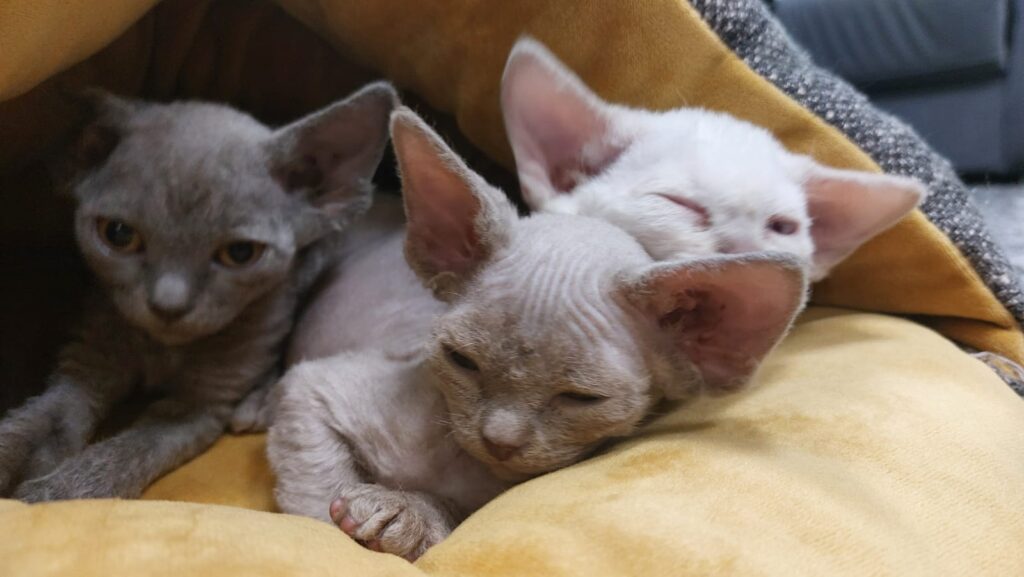
One of the more frequently arising questions when planning to buy a kitten – is, which sex to choose?
Sometimes it happens that someone comes to us who already has an idea and a plan that they absolutely want a female (or a male). And we respect that – everyone may want to look for a specific companion for life. But we have had cases changing this decision after talking with us, and from what we know – everyone was satisfied with their final decision 🙂
Theories and rumors
You often hear that male cats are friendlier and more cuddly than females (but also that they are bigger rascals). And that females are more independent and keep a bit of a distance. You can come across opinions that females are less aggressive, much easier to raise, more curious, eager to play and cuddle, and gentler than males. There are theories saying that females are aloof and easier to annoy.
As many people (and cats!) as there are opinions… and some of them may be true, if the cats are not neutered, if they were not well socialised and if they are cats of breeds other than the Devon…
So what is the truth about these sexes?
Let's start with a few important conditions, because we mean:
- a Devon Rex cat – because they have a distinctive character and that is what we breed
- a cat from a cattery (ours) – that is, strongly socialized
- a neutered cat – because only such ones leave our cattery
And the short answer (under the above conditions) will be – SEX DOES NOT MATTER 🙂
Pedigree cats have specific behavior patterns, so a Devon Rex in this respect will generally be very pro-human, cuddly and squeezing in everywhere (generally regardless of sex).
Ultimately a cat's character depends mainly on its individual predispositions and socialization at the cattery (you can see how we socialize our cats).
That is, if you want to, you can stop reading here 🙂 But if you feel like it, take a look at a few additional pieces of information on this topic…
Do you want a more cuddly cat?
One thing you already have as part of the package – you chose the Devon Rex breed, which by its nature is very friendly to people and in most cases simply likes to cuddle.
The second thing we provide ourselves – early and fantastic socialization, which has a huge influence on how the cat then behaves in its new home. In this context, beware of catteries that release cats before 14 weeks of age. The longer a cat stays in the cattery the better for its character and socialisation – we release ours at around 16 weeks.
The third one is The time you then spend with the cat. The more time you devote to it, the more willingly it will come back to you and show its affection. Also make sure it has resources (scratching posts, climbing frames, places to sleep). And in the end the cat will surely appreciate it and gladly come back to you for more. One small note, though – respect the cat's boundaries – they sometimes like to sit/sleep away from us. Don't force them to cuddle or sit on your lap, and you'll see they'll come back to you on their own.
Are there really no differences?
With our experience and quite a number of kittens already released to new homes, there really are no differences between the sexes, but…
There can indeed be two differences:
- Size – females are usually smaller/finer than males, but in Devons there are not such drastic differences (although they do occur). Males, on the other hand, may have a greater tendency to put on weight (even though Devons are naturally slim cats).
- Color – if you dream of a tortoiseshell (a two- or three-coloured cat – red + colour + possibly white), it will only be able to be a female (a male tortoiseshell has a genetic defect). The same with the colour red – here there are decidedly more males (only about 20% are females). However, all other colours – you will find a female and a male without any problem.
The third difference – though we haven't come across studies on this, rather theories – is that female cats may be slightly less allergenic. This is because the allergenic factor is a protein found in sebum or saliva, and male cats have more sebaceous glands than females, and consequently may theoretically secrete more of this protein (but this again – is a matter individual to the cat and it is hard to measure and predict).
A second kitten in the home
And what if you already have a cat at home and are wondering what is best to match with it? The same sex or a different one?
We will start with the fact that Devons are best taken in a pair 😀 And it's not a joke, we described more in a separate guide titled 6 reasons why Devons should be bought as a pair.
However, if one cat already lives in your home, it doesn't matter much what sex the next pet will be.
Even though you can come across the opinion that mixed pairs get along best, in our opinion what matters most is still the character of the individual cat. And here too a combination of the characters of two cats (the current and the new one).
So the question is whether you have a moggy at home, or maybe a cat of another breed, or maybe another Devon, or maybe you have a cat with specific problems? Here it is hard to describe everything in a guide (which was meant to be short), so we suggest talking with us here – we will give tips and advise something from our experience. We will also tell you more about socialisation, so important when adding another cat to the home (you can also read our guide about it yourself). However, in our opinion in this case – there is absolutely no point in going by sex alone.
The caregiver's sex
It is also an interesting topic, which we sometimes discuss with the potential parents of our kittens.
Because we sometimes hear „well, because the previous cat always chose the wife„, or „this time I would like a kitten that will come more to me than to my husband” 🙂 Here too we will say right away – Your sex also does not matter!
Cats, regardless of sex (their own and the owner's!), they choose one „main user”, with whom they most often spend the most time and to whom they are most drawn. It is to them that they often come to be fed or played with, on their laps that they sleep more often, to them that they come to bed.
On what basis do they choose? The key factors are of course first interactions (the meeting at the cattery, transport, the first moments in the new home) and the way the Owner relates to the cat.
Even if the whole family loves the new cat, even if the whole family devotes a lot of attention to it – there will always be someone who feeds the cat more often, plays with it more often, takes care of it more often. Cats notice even small details that we don't always see, and on that basis they set up a hierarchy of household members in their heads. Sex has rather little to say here.
However, this does not always work either. Sometimes even the greatest willingness and dedication of one person will not make the cat choose them as the most important one 🙂 Some of our new families (including ours!) know this pain too. Here sometimes nature and instinct simply take over.
Finally one „but”… Cats have a very keen sense of smell. And sometimes it happens that the natural scent of one of the household members (a woman, a man, a child) simply works better on this particular cat. And here too there is rather nothing we can do 🙂
In summary…
So finally – tom or queen? We are of the opinion that it does not matter, but the final decision still depends on you – so as you prefer 🙂
Other interesting posts
Physics cats – where do some of the Kotki Kędziorki names come from?
Sometimes it happens that someone asks us – where does such a „strange” name for a cat come from? And this „strange” often comes up with cats that have less standard names than, say, Chmurka, Atena, Bella or Kiwi. So it's probably time to tell you a little story about where some of our cats' names come from. Aneta is a physicist by education […]
Microchip in a cat – why is it worth it and what does it look like?
Microchipping your cat (chipping cats) – read about what a chip is, how it works, what a new Parent should know about it, what the costs look like, what microchipping cats involves (and whether it is painful), whether there are legal requirements for microchipping, whether every cat can/should have a chip, a few myths about chips, how catteries approach it, how we approach it, and finally two examples of how to use chips in a cat in an interesting way 🙂