Microchip in a cat – why is it worth it and what does it look like?
Like many of our guides/articles, this one too began with a question that came to us – „what this cat chipping is all about” and then a few additional detailed questions and discussion about it.
Hence today's topic – a chip in a cat (chipping cats). We'll write about: what a chip is, how it works, what a new Parent should know about it, what the costs look like, what microchipping cats involves (and whether it is painful), whether there are legal requirements for microchipping, whether every cat can/should have a chip, a few myths about chips, how catteries approach it, how we approach it, and finally two examples of how to use chips in a cat in an interesting way 🙂
What is a chip and how does it work?
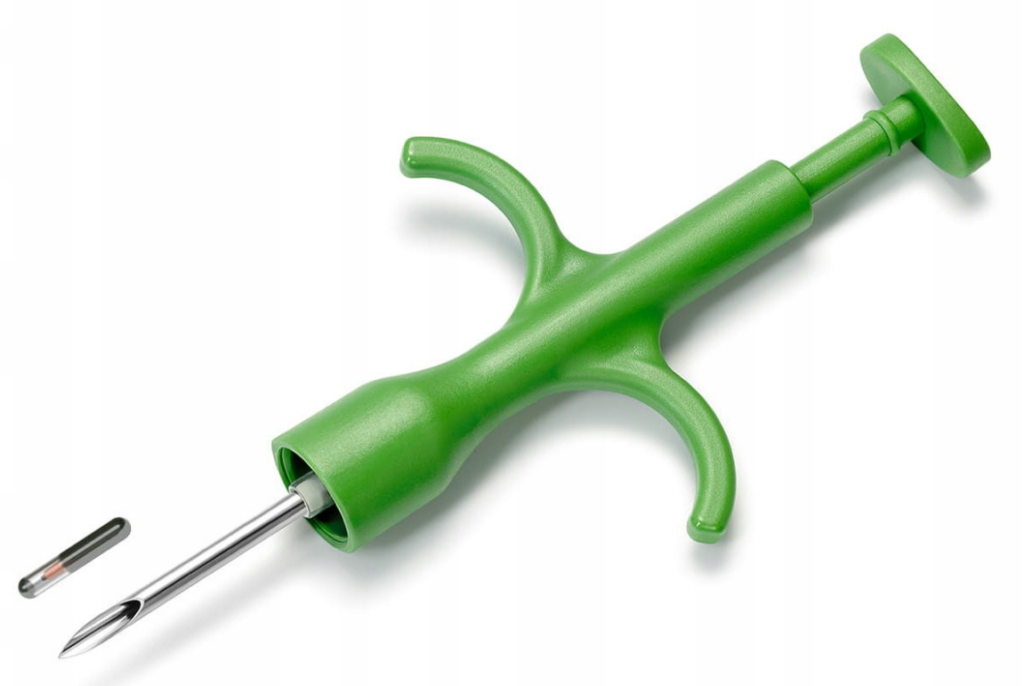
A chip is a tiny electronic element (the size of a grain of rice) enclosed in a special protective capsule, which it is implanted under the animal's skin – most often between the shoulder blades. The procedure lasts a few seconds and is comparable to an ordinary injection.
✅ The chip does not emit waves/radiation, does not hurt the cat, does not move about, does not require a battery (or its replacement), is completely maintenance-free for the owner and for the cat it is for a lifetime.
🪪 Contains a unique identification number for the cat (and only this number, nothing more!). It's a bit like a human PESEL [national ID number]. Practically every vet should have readers for these chip codes, and if a cat is found, the vet can check this „feline PESEL”. Such readers are also held by border services, animal shelters, and sometimes the police or municipal guard. It works from a distance of about 5-8 cm.
Fun fact: We have a chip reader in our cattery, so if you feel like it, ask us at collection or during a visit to check the chip number of a chosen cat or several of our cats 🙂
The code in the chip consists of 15 digits – those sold in Poland should start with „616”. There can be various chip manufacturers, but their production is supervised by the International Committee for Animal Recording (ICAR), which assigns numbers to all producers.
⚠️ VERY IMPORTANT: However the chip itself is just a number! It contains NO data about the cat, breeder or owner! That is why, for it to fulfil its task – very important is its registration (more on it in a moment). Remember that a chip without registration is practically useless!
PS. We have also come across other suggestions for identifying a cat – a tattoo or a pendant (an address tag). But both these options have big drawbacks – a tattoo has to be done under anaesthesia and may fade over time, and a tag can be dangerous (the cat may choke or get its collar caught, e.g. on a fence).
Should/must every cat have a chip?
Well, this is an interesting question – because it is here that the important the differences between chipping as a legal obligation and the requirements of feline organisations (i.e. those that issue pedigrees).
👮 Do breeders have to chip cats?
Polish law does NOT impose a general obligation to chip cats, even in the case of their sale. This means that in theory a person breeding cats (not necessarily acting in accordance with breeding rules!) may sell a cat without a chip. Also, of course, many non-pedigree cats („moggies”) do not have a chip.
✅ But… most feline organizations REQUIRE a chip
In practice, if the cattery operates legally, under the auspices of a recognised organisation (such as FIFe/FPL, TICA, WCF, etc.), the microchip number is mandatory in the cat's documentation.
Most often:
Chipping is required before handing over the cat to a new home.
The microchip number must be entered in the pedigree.
In some organisations chipping is required already at the stage of litter registration.
Thanks to this the new caregiver has certainty of the cat's identification and can link a specific animal with documents (pedigree, passport, health record).
A chip is also essential if in the future you want to to exhibit the cat at shows (because „pet” neutered cats can also take part in shows!).
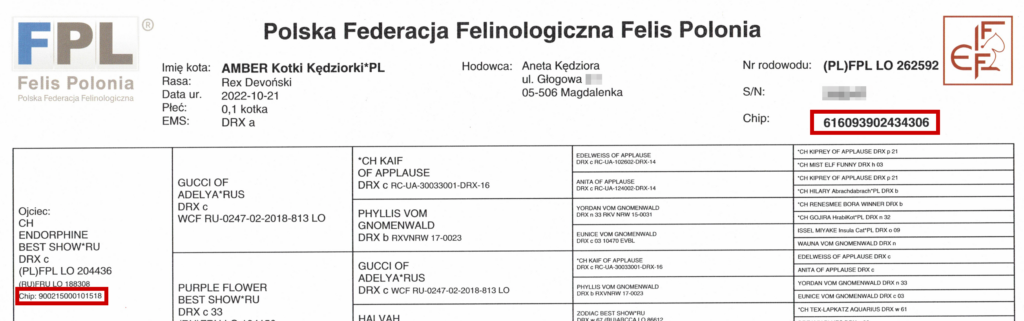
You will find the chip number on the cat's paper pedigree, it should also be visible for the parents of a given cat (or at least it is so in FPL).
🚗 Travelling with a cat
Additionally, if we want to travel with the cat outside Poland, the cat must have passport for pets. And in the passport the cat must be unambiguously identified and that is why the chip number is given there.
Chip registration – a super important matter!
We return to this super important topic – chip registration. If the cat has only an implanted chip (it of course has that unique number then), but has not been registered in any database, then the information about the owner will NOT be saved in it (that chip).
That is, if someone finds a cat, the vet can check its number, but will not find information about the owner (or breeder) and will not know who to contact!
Where to register the cat? Where is the chip registered?
There is no single central, worldwide animal database, but there are several of the best-known, most popular and largest databases – the Polish ones also pass data/information to these European or global ones. It is in them that vets (or other services) most often check the data.
Further on we will describe them in detail (including information about costs, etc.), but here let us list these 3 most popular ones in Poland:
Safe-Animal (we register in it at Kotki Kędziorki*PL)
Identyfikacja.pl
CBDZOE
Who registers the chip?
In the context of chip registration there are two options:
The new owner registers the chip in the database
The breeder registers the chip in the database (we recommend this!)
❌ Unfortunately there are breeders (and we know this from stories) who do not register the cats, but leave it to the new owner. In the flood of information about the new kitten, they often forget about it and then the cat had a chip, but it was completely useless, because it had no data entered.
❌ An even worse example (also from stories) are breeders who did not even implant the chip but only gave it by hand in a syringe! They could give this chip number for the pedigree, but they no longer bore the cost of implanting it, or of registering it in the database. In that case the chance that the chip will be implanted by the new owner and registered – is in our opinion negligible…
✅ At Kotki Kędziorki*PL it is we chip and register all kittens on the occasion of the second vaccination – that is around the 12th week of life.
✔️ Each of our kittens receives a chip with a unique number. ✔️ This number is immediately registered in the Safe-Animal database. ✔️ As the data sociable we give our cattery there, but the new owners can change it. ✔️ New owners get a sticker in the health record with the chip number
Thanks to this, from its very first day in a new home our kitten is safe, and its data is ready in case of need.
Searching for information about the chip/cat (Safe-Animal)
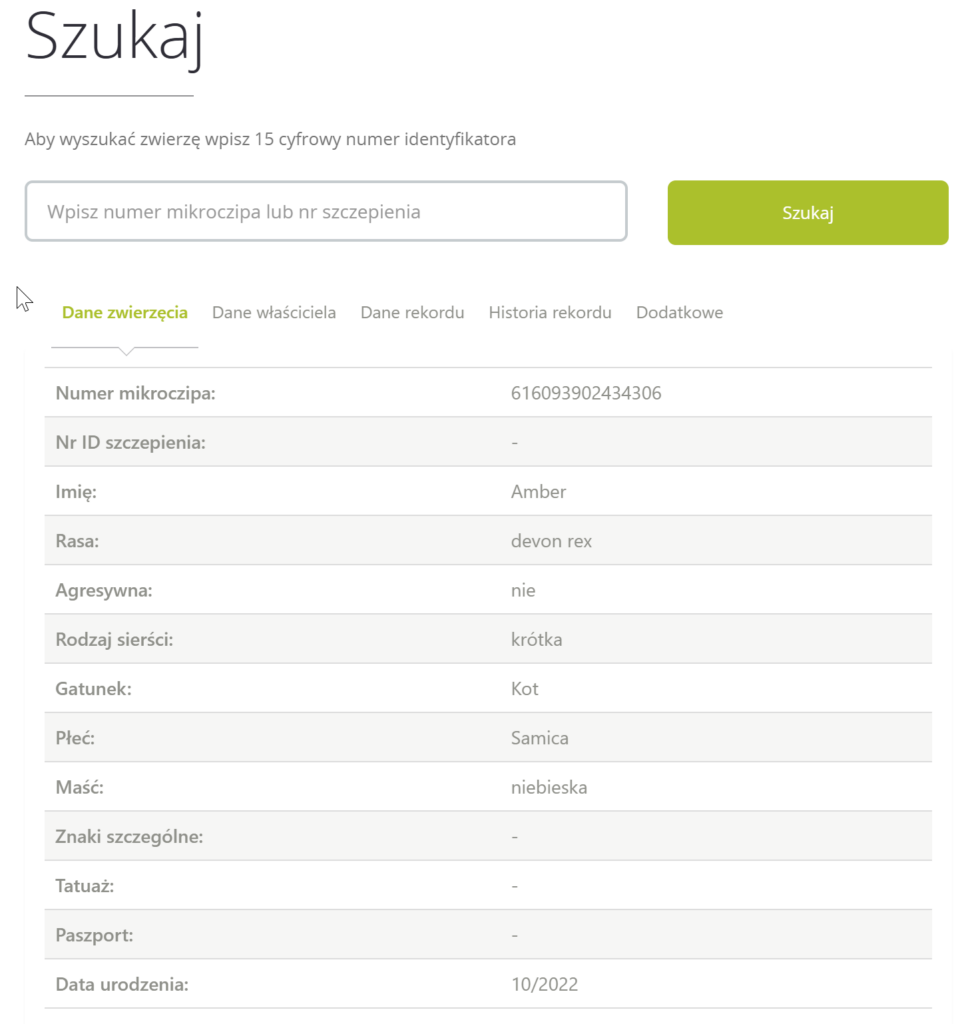
See in the example below what searching for information looks like about our queen Amber in the Safe-Animal database.
An example result of searching for the chip of our cat Amber.
Want to try? Go to Safe-Animal and enter her chip number: 616093902434306.
🪪 You can also do this with your cat's chip number and to make sure whether it is registered and what data is provided with it!
Searching for information about the chip/cat (FPL)
If the chip was NOT registered, there is still one more option for checking to whom the cat may belong, but it has certain limitations.
Our federation, to which we belong – FPL Felis Polonia, gives the possibility of checking the chip number of any pedigree cat in FPL. There will be no cats from the WCF or TICA federation there, but it is always some kind of start if a cat without a registered chip is found.
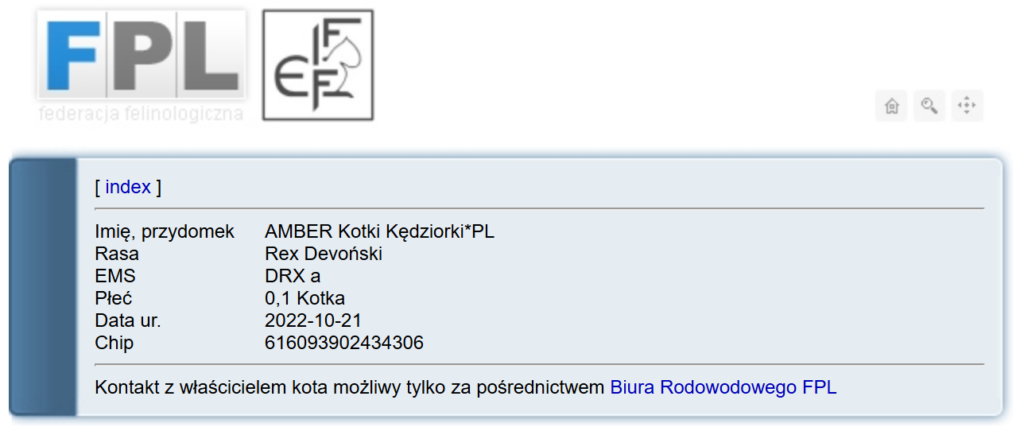
After giving the chip number you will receive information about the name, cattery affix, breed, colour, sex, date of birth. And if someone (including you) were to find a cat with such a number, you can to check which cattery it is from, and then contact them (via the FPL Pedigree Office), and they may find out to whom the kitten was sold (as long as they also keep correct breeding documentation) and thus may find the owner (provided the chip was not registered).
An example result of searching for the chip of our cat Amber.
Want to try? Go into the FPL Pedigree Office and enter the chip number of our Amber: 616093902434306. Or of any other cat with a pedigree in FPL.
Note: The obligation to give the chip number in the FPL pedigree came into force in 2007. Cats with an FPL pedigree issued before that year may not be found in the FPL pedigree database. Fun fact: from 1 July 2018 a FIFe resolution (no. 8/2018), adopted by the General Meeting of Members, is in force, which requires the microchipping of kittens before the pedigree application – the chip number must be entered into the litter document, and without it the pedigree will not be issued.
Why is it worth chipping a cat?
You have probably already guessed why it is worth chipping a cat. But let us put it plainly. Because even a typically “indoor” cat can get out of the house – through an ajar window, a balcony, a door, during a visit to the vet or an escape in a stressful situation.
A found cat without a chip has no identification – it cannot be verified to whom it belongs. However a chip registered in a publicly accessible database allows quick contact with the carer, shortening the time of separation and increasing the chances of a happy return of the animal home.
✅ Safety and a chance of returning home – if a cat runs away, goes missing or is stolen, a vet, shelter or foundation can read the chip and contact the owner.
✅ Help in crisis situations – an accident, an evacuation, the carer's hospitalisation – thanks to the chip it is known to whom the animal belongs.
✅ Proof of ownership – in case of a dispute, e.g. if someone takes in our cat, the chip is legal proof that it is our animal.
✅ A requirement when traveling abroad – cats travelling outside Poland must be chipped if we want to obtain a passport for them.
What does the chipping itself look like?
The procedure is performed by a veterinarian and it is very quick and relatively painless:
The cat is identified and examined (for older cats without a known history the vet should first check whether the cat does not already have a chip).
In the spot between the shoulder blades / on the left side of the neck the chip is implanted using a single-use needle.
The vet reads the chip (to make sure it works and it is possible)
The number from the chip is entered into the health record and/or passport.
The chip should then be registered in the database right away
The procedure is quick, cheap and done once in a lifetime – the chip works for the cat's whole life.
The most popular databases in Poland
All right, you know what chipping looks like, why it has to be done and how. Remember that a chip without registration is like luggage without an address or a PESEL without address information.
In Poland several databases operate, but these 3 below are probably the most popular and checked by vets.
Registration 65 PLN (regardless of the number of animals)
* The European Pet Network (EPN, EuroPetNet for short) is a non-profit organisation that brings together the databases of European countries. This means that this organisation's search engine browses the databases of all these countries, so we can easily find a pet even beyond the borders of our own country.
What do we use?
As we mentioned – at Kotki Kędziorki*PL we use the Safe-Animal database. In our opinion it is the largest database, with a well-prepared website, information about the cat.
We chip the cat at the cattery, and register it in Safe-Animal. After collecting the kitten you do NOT have to do anything, you do not have to buy a paid Safe-Animal subscription!
In the Safe-Animal database, the information about your cat contains the data of our clinic (Redline) and our contact details (telephone number).
If you would like change this data there are two options:
You buy a Safe-Animal subscription (annual or lifetime) and then you can make all changes and edits to the cat's data in the database yourself. You can also decide what is visible there.
You can report this fact to us and then we will make this change free of charge by our clinic.
From our experience – most new owners leaves this data unedited – in case the kitten gets lost and is found, someone should get in touch with us, and we have your contact details and can help. But you can change this – it is entirely up to you.
⚠️ ATTENTION: If ever you bought the Safe-Animal subscription (for a year) and you will not want to renew it (because you do not want to pay any more) – then the data about the cat are NOT deleted from the database. They stay there forever, and only you lose the possibility of editing them. We add this, because it is also one of the questions we have discussed more than once.
Myths about chipping cats
And almost at the end, a few more myths that we have heard and had the chance to discuss:
❌ The cat CANNOT be located using the chip. It is not a GPS device that will show us the cat's location. There is also no data stored in the chip itself, and it is we who decide during the registration of the chip in the database what will be shown to the person who finds it (e.g. only a telephone number).
❌ Chipping and registration is NOT costly, and in the case of responsible breeders it can even be free of charge for the new owner. The cost of implantation is from a few dozen to 100-150 zł (depending on the chip manufacturer, the vet and registration). Some municipalities occasionally organise free cat microchipping campaigns – it's worth taking advantage of them if your cat doesn't have one yet.
❌ The chipping procedure is NOT complicated and difficult. It lasts literally a minute, the cat does not have to be anaesthetised, does not have to undergo any recovery, most vets will perform chipping without any problem.
❌ The chip does NOT interfere with the cat's functioning at all. The chip does not irritate the tissues around the place where it is located, and the animal also does not feel any itching. It happens that it is even hard to feel it through the skin.
❌ there are NO age restrictions when a chip can be installed. It can be done on a tiny kitten, but it can also be done on a fully adult cat.
❌ You canNOT do it yourself (in a simple way) to read the chip. You have to have an RFID chip reader. That is why if you find a cat it is best to take it to the nearest vet.
❌ The chip CANNOT be lost by the cat, nor can it be pulled out by a stranger. A chip is also never replaced.
❌ Every cat can be chipped. It makes no difference whether the cat is pedigree or not.
What else can the chip be used for?
As we mentioned, a chip is only 15 digits, but there are two quite interesting solutions that use this simple possibility of identifying a specific cat.
Chip bowls
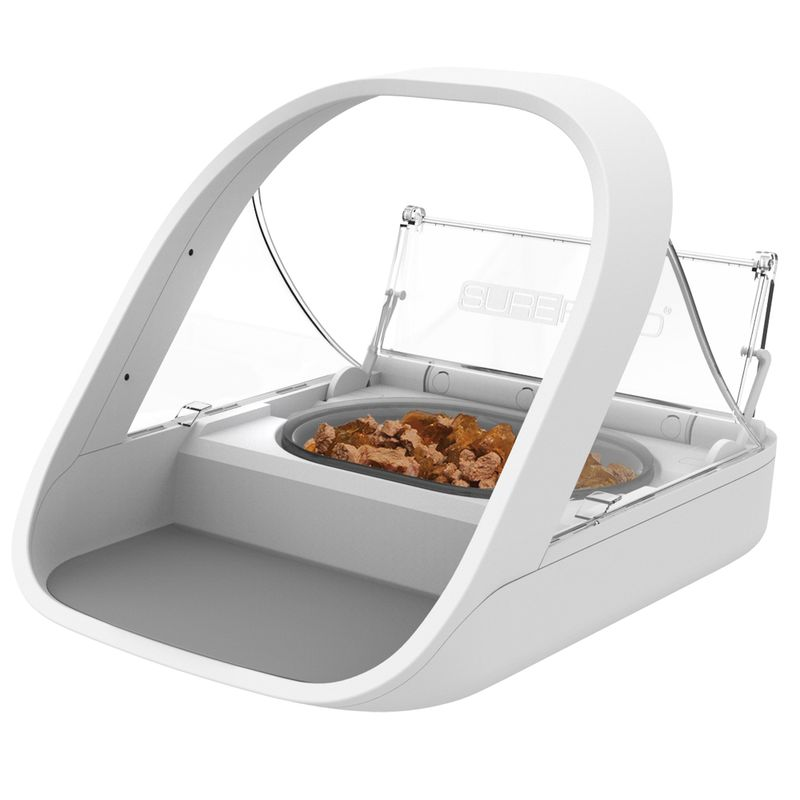
There are food bowls for cats that can recognise a specific cat and open up only for it and give it access to food.
This works above all in a situation where at home we have more than one cat and there are two situations then:
If we have to give a specific cat (and only it) a specific food. For example when only it can/must eat a specific type of food.
If we want to have cats that eat a shared food, but to one of them we have to add extra just for it.
There are quite a few bowls of this type, we do not have any so we will not recommend a specific one, but look under the phrase „chip bowl”.
Chip entries
It may happen that we want to let our cat out of the house or, within the house, restrict a specific cat's access to a specific room.
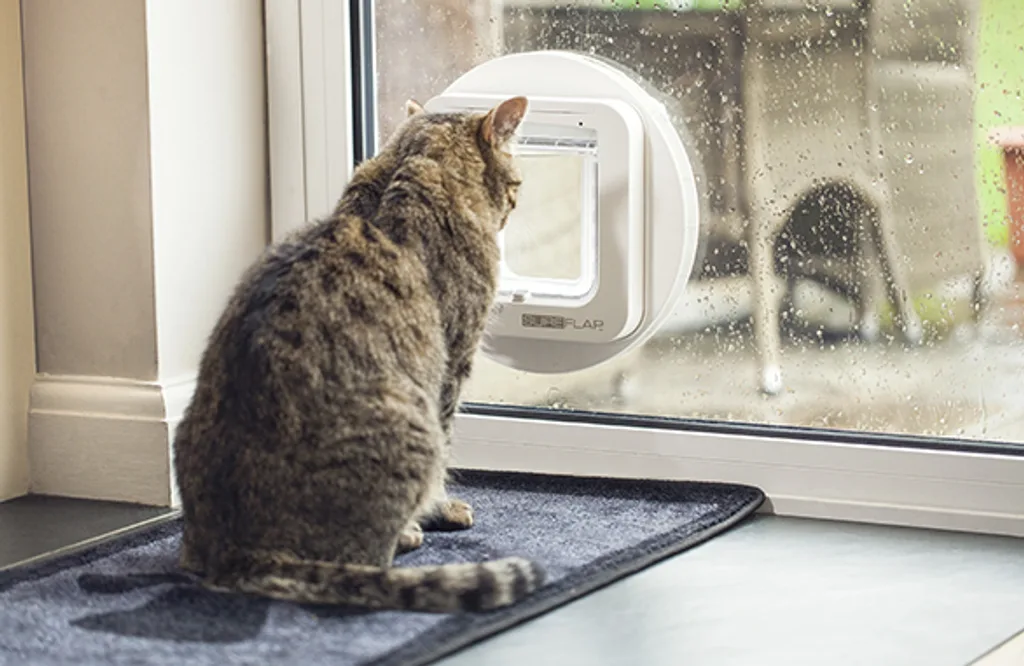
Such entrances (mounted in doors) have a sensor which of course recognises the chip and it is we who can decide for which cats these doors will remain closed and for which they will open.
Here too we have no experience, so it remains for you to search online for the phrase „chip cat flap”.
Summary
Chipping is a simple, cheap and very effective way to increase a cat's safety. It works throughout its whole life, does not bother the animal, and in case of problems – it can save a life or help it return home.
In our cattery we take care of this from the very beginning – because responsibility for the cats does not end on the day of their release 💚
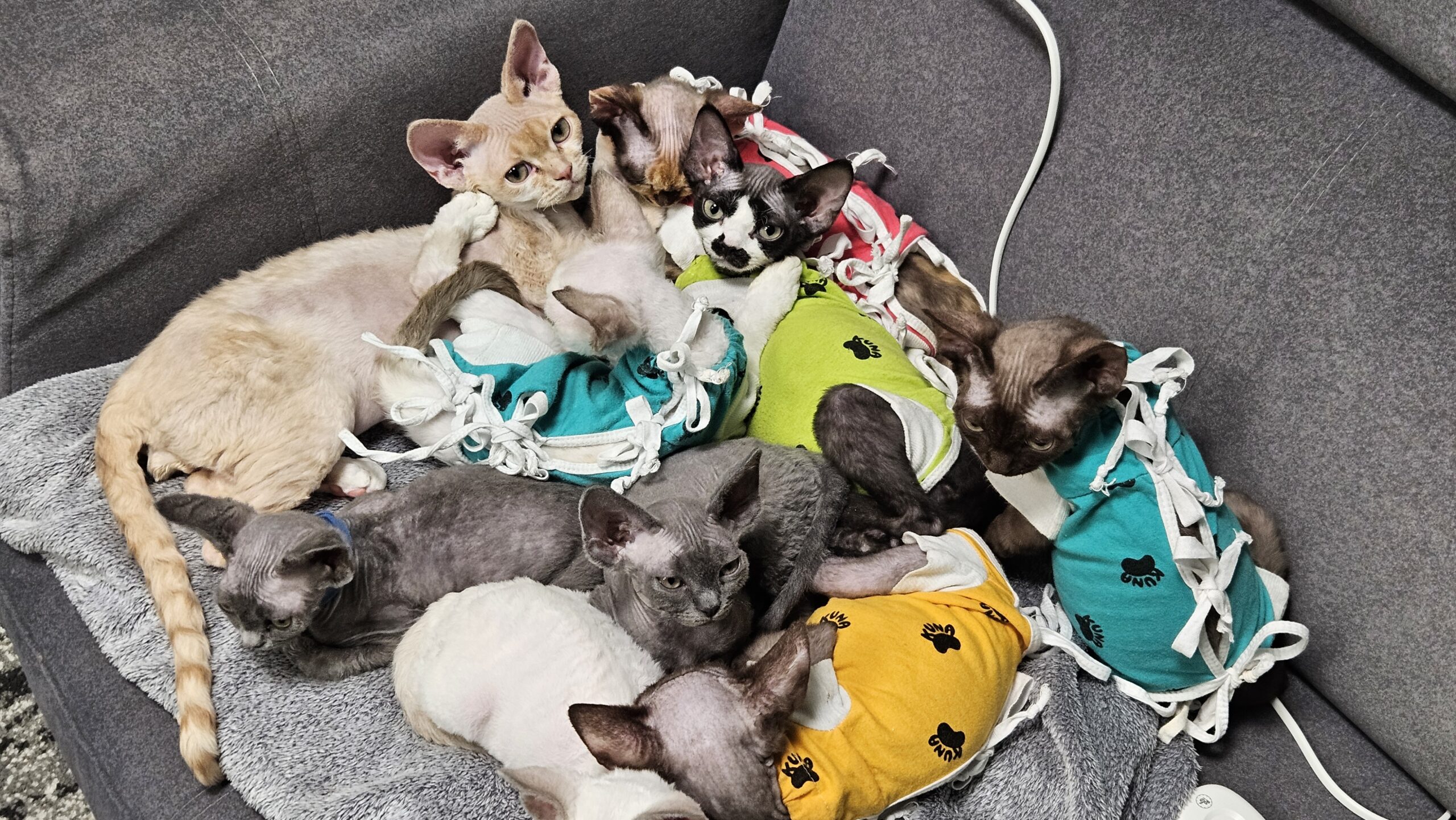
Interested in a Devon Rex?
If you are interested in a Devon Rex kitten from our cattery, then:
You can also follow us on Facebook, Instagram and TikTok – we also regularly publish lots of photos, videos, and information there. Like and follow our profiles to stay up to date with what’s happening with us 🙂
Early neutering of cats, carried out before they reach sexual maturity, is standard in responsible catteries. It provides health benefits, minimises stress and simplifies life for new owners. This practice, supported by experts, is aimed at ensuring the safety and health of cats, not at profit for breeders.
Collars on cats still stir emotions – especially when someone posts a photo of a cat with a small, „cute” strap around its neck. Unfortunately, what looks innocent is in practice often one of the most common and most dangerous items in a cat's „starter kit”. This guide was created to explain why collars on cats are risky, what consequences they can have, what […]
Cat socialisation is one of the most important stages in a cat's life, especially in its first days and weeks. It is precisely then that its reactions to the world, to people and to other animals take shape. In our cattery we attach enormous importance to this.